
If you’re thinking about traveling to South Africa stop thinking and start organizing it. Africa’s southernmost country is a major destination, perfect for a first foray into the continent, friendly, hospitable, and best of all, with a fascinating and very varied cast of landscapes and attractions capable of satisfying any nature lover.

Traveling to South Africa is, without a doubt, a great decision and doing it on your own is a total success if what you like is to enjoy without the rush of an organized tour and with total freedom.
Traveling to South Africa: 4-week itinerary
The southernmost country in Africa is immense and has a lot to see: national parks where you can spot wildlife, beaches from which to see whales, cities full of history and contrasts, one of the seven natural wonders of the world such as Table Mountain, wetlands, mountains, vineyards… Shall I go on?
With so many attractions, if you are going to travel to South Africa, deciding which route you are going to take, which places to visit in South Africa and which ones you will leave out will take you some time.
In case it helps, here is the route I took during my independent trip to South Africa for 4 weeks entering through Johannesburg and leaving through Cape Town with a domestic flight between Durban and Port Elizabeth to save kilometers and two car rentals.
Keep in mind that this has been a trip through South Africa with small children aged 5, 3 and 1, so the pace was slower. If you aren’t bringing kids, obviously you’ll be able to do it in less time.
- Johannesburg – Dullstroom – 1 night
- Panorama Route – Hoedspruit – 2 nights
- Kruger National Park – 3 nights
- Hlane National Park (in Eswatini, former Swaziland) – 1 night
- Pongola – 1 night
- St. Lucia – Isimangaliso Wetland Park – 3 nights
- (domestic flight from Durban to Port Elizabeth)
- Addo National Park – 2 nights
- Tsitsikamma National Park – 2 nights
- Mossel Bay – 1 night
- Swellendam – 1 night
- De Hoop Nature Reserve – 2 nights
- Hermanus – 2 nights
- Cape Town – 5 nights
Here is the map of South Africa with my route including the points I visited, as well as the accommodations. Later, I will write a detailed post with all the places to visit in South Africa, as well as different route proposals.
When is the best time to travel to South Africa?
To start with, assume that you can travel to South Africa at any time of the year. However, depending on what you are looking for, some months will be more recommended than others. Also, in case you hadn’t realized, keep in mind that the seasons are ‘backwards’ compared to Spain.
- Spring: From September to November.
- Summer: From December to February.
- Autumn: From March to May.
- Winter: From June to August.
If whale watching is one of your motivations for traveling to South Africa, the season runs from June to December when they come close to the coast to mate and have their calves.
You can go on a safari at any time because the wild animals aren’t going anywhere. While it is true that in winter, during the dry season, it is easier to spot them because they gather at the watering holes to drink and there is less green foliage to hide in. However, in summer you might coincide with the birthing season and see many calves, in addition to the arrival of thousands of birds.

In my case, I traveled during the South African spring, specifically from October 12th to November 9th and, although I cannot compare, it seemed like a good time to me. You are still in time to see whales in places like Hermanus, De Hoop or Santa Lucia; you are not yet in the middle of the rainy season, the temperature is good, and you have about 12 hours of sunlight.
If I had to recommend a time to travel to South Africa it would be, for example, the months of September and October. But it can always be a good time to visit this great destination.
Time difference with South Africa
The good thing about this destination is that you forget about jet lag because there is no time difference with Spain.
The only time of year when it is one hour later in South Africa is during our winter when we change the time in Spain at the end of October.
What is needed to enter South Africa?
Documentation for traveling to South Africa
As of today, March 2024, no visa is necessary if you are traveling from Spain, unless your stay exceeds 90 days.
Thus, to travel to South Africa you will only be asked for your passport. But be sure to check the expiration date, which must be at least 30 days after the day you plan to leave the country.
Regarding COVID-19, since June 2022 all restrictions in this regard have been removed. You do not need any type of COVID certificate, test, or PCR to enter the country; it is not even mandatory to be vaccinated anymore. You will not be required to wear a mask during your stay either.
Even so, do not fail to check the conditions on official pages such as the Embassy of South Africa or the Government of South Africa before flying to ensure that nothing has changed. You can also consult the website of our Ministry of Foreign Affairs, but be careful because not all the information that appears there is 100% updated, as I will explain now.
If you are going to rent a car in South Africa, remember to make an appointment at the Traffic Department to request an international driving permit.
Requirements for traveling to South Africa with children

If you are traveling to South Africa with children, you do not need any special type of document beyond their passports as long as the minors are accompanied by at least one of their parents. In November 2019, the previous requirement to carry a literal birth certificate, or failing that, the family book, translated, was repealed. This information is still not updated on the website of the Spanish Ministry of Foreign Affairs. Here is the official statement announcing that to enter South Africa, foreign minors only need a valid passport.
What vaccines are needed for traveling to South Africa?
Currently, no vaccine is required to enter South Africa.
The only exception is if you have previously been to a country where there is yellow fever, in which case you must present the corresponding vaccination certificate.
However, I always recommend going to a doctor and even better to a Traveler’s Unit to receive recommendations from specialist doctors.
In Madrid, I always go to the Tropical Medicine and Traveler’s Unit at the Carlos III Hospital. Make an appointment at least one month before the trip by calling 914 532 672 and 914 532 780. Here they only see adults.
If you are traveling to South Africa with children or adolescents, you can make an appointment at the Child Traveler’s Unit. In Madrid, for example, it is in the La Paz Hospital, on the ground floor of the children’s hospital. You can make an appointment by calling 91 727 72 01 and 91 727 16 44. The pediatric and nursing team are very attentive; they will take a brief history of the little one and give you all the necessary recommendations for a peaceful trip.
In my case, my 5, 3, and 1-year-old children were given the hepatitis A vaccine as a precaution and we were prescribed pediatric malaria prophylaxis, as we were going to a risk area for a few days.
In both units, they will inform you of the sanitary and hygienic precautions you should take, they will give you the relevant vaccines, and they have all the updated info about malaria zones.
Money and Currency of South Africa
The official currency is the South African rand whose code is ZAR. The exchange rate fluctuates as normal, but to give you an idea, 10 rands would be about €0.55 and, therefore, 100 rands would be equivalent to about €5.50. As a curiosity, the banknotes have Nelson Mandela’s face and the Big Five printed on them.
The use of credit and debit cards for payment is more than widespread throughout the country. During my trip, I used the Revolut card almost everywhere without any problem, both for paying and once to withdraw money from the ATM without being charged a commission.
Even so, it is advisable to always carry cash. One of the reasons is that, sometimes, due to the almost daily power outages in South Africa, you may not be able to pay by card. Without electricity there is no internet and without a connection the POS terminal doesn’t work for card payments. This happened to us, for example, inside Kruger National Park and at one or two gas stations.
In restaurants, it is common to leave a tip of at least 10% of the bill. It is so common that when they bring you the bill, you will often see a specific space at the bottom for you to write the tip you are leaving so they can charge it all together.
It is also common to leave a tip at gas stations where they will always clean your windshield and mirrors. Leaving at least 10 rands, which is about 55 cents, is enough. If you leave 20, they will be even more grateful and you will leave with spotless windows.
In some parking lots, it is also common to leave about 10 or 20 rands as a tip for the person watching for security.
How to get to South Africa
The country has three international airports: O.R. Tambo in Johannesburg, Cape Town in Cape Town and King Shaka in Durban. If you are flying from Spain, the most common and fastest way will be to fly to one of the first two, depending on your departure city and ticket prices.
Keep in mind that there are currently no direct flights to South Africa from Spain, so you have to make at least one layover. However, pay attention because they could reinstate the direct route that existed some time ago at any moment, for example from Madrid to Cape Town with Iberia.
In my case, I flew from Madrid to Johannesburg with a layover in London with British Airways. And I returned through Cape Town, also via London. The price of the round-trip ticket to South Africa from Madrid was €580 per person, including one checked bag up to 23 kilos.
You can find cheaper flights if you buy them well in advance; I did it only three months before. You can also save if you don’t mind making more than one layover and if you have flexibility with both dates and times that may not be the best. In my case, I paid a little more so the long 10-hour flight would be at night, which is more suitable when traveling with very young children.
If you are flying with children....

Children from the age of 2 pay the same as an adult.

Babies under 2 pay only taxes, but this varies depending on the airline and also on the distance. On this particular flight I paid €180 return for the baby's ticket.

Bear in mind that, as you are not paying for a full ticket, babies are not entitled to a seat, so you have to hold them on your lap. You can request a bassinet in advance for the 10-hour leg, but you have to book one of the seats with a bulkhead in front, as those are the only ones where it can be fitted.

You should also know that paying only taxes means the baby's meal is not included either. Do not forget to take enough food for your baby, and something for breakfast if the flight is overnight. Depending on the airline and how kind the crew are, they may give you a spare meal or not, find you a little milk or even a jar of baby food, or give you absolutely nothing at all for the little one.
How to get around South Africa
Traveling to South Africa implies dealing with the long distances of this country. In any case, whether you choose to visit only one part or bet on traveling from end to end, the most recommended way to get around South Africa is to rent a car.

If you are only going to be in Cape Town and the surrounding areas, you don’t need to rent a car if you don’t want to. Within the center, you can get around with public transport. The easiest way is to take the MyCiti buses that work with a card you buy next to the stops and top up with money (you can later use it to pay in stores without commission because it works like a debit card).
With MyCiti buses you can go to all the tourist spots in the city such as Table Mountain, Bo-Kaap, or the V&A Waterfront. This transport system even works for traveling beyond the center; for example, you can go to Camps Bay beach to see the twelve apostles or reach Hout Bay to see sea lions.
In Cape Town, the use of UBER is very widespread for getting around.
Renting a car
Driving your own vehicle allows you to travel with total freedom, more comfort, and on your own schedule. Another advantage is that you can go on a self-drive safari in your own car in national parks like Kruger or Addo. Remember that you need an international driving license.
That said, keep in mind that in South Africa you drive on the left. At first, it takes a bit to adapt, but you soon become familiar. Later on, I will write an article dedicated exclusively to driving in South Africa with practical tips.
Regarding the rental car for South Africa, you can get around with any type of vehicle as the road conditions are very good, in general. It is true that there are some that may have holes, called potholes there, in the asphalt, but if you pay attention you can dodge them without any problem.
A 4×4 is not essential for getting around South Africa, not even for going on a safari within national parks like Kruger or Addo, which have a main paved road and well-maintained dirt tracks.

While it is true that if you go during the rainy season and plan to do safaris in your car, then I do recommend renting a 4×4 to be able to travel anywhere without problems. Puddles and mud will make it so that you cannot access some tracks with a normal car.
For the safaris, I also recommend choosing a vehicle as high as possible, which gives you greater visibility for spotting animals.
In my case, I rented a car twice, once from Johannesburg to Durban and another from Port Elizabeth to Cape Town. On both occasions, I chose a seven-seater Toyota Rumion because, traveling with three very young children, we needed a wide car to fit the child seats and with enough trunk space.
After much searching, I found the best price on AutoEurope for a car with Europcar. In total, 26 days of rental for €908, which gives an average of €35 per day including the surcharge for picking up and returning the vehicle in different cities.
By train through South Africa
The most famous means of transport for traveling through South Africa is the train. If you are one of those who likes to enjoy the landscape without having your hands on the wheel and you are nostalgic for this way of moving, this country offers options ranging from simple transfers to the privilege of traveling across much of the country sleeping on the most luxurious train in Africa, the Rovos Rail.
Rovos Rail even offers itineraries with safaris, stops at golf courses, and even the possibility of taking you to Namibia or Victoria Falls. Obviously, this is only suitable for very wealthy travelers. The same applies to The Blue Train, another luxury option that also has a lot of history with its wooden carriages and steam locomotive.
But stay calm because there is a third option that won’t cost you an arm and a leg. The most accessible company to travel through South Africa by train is The Shosholoza Meyl. Its lines connect most of the cities throughout the country with three different classes—economy, tourist, and premier—to fit all budgets.
Domestic flights

Depending on the South Africa itinerary you are going to follow and the days you have, it might be worth taking a domestic flight to save time. In my case, I opted for a domestic flight between Durban and Port Elizabeth to save myself nearly 1,000 kilometers and 12 hours of driving.
There are several companies like Fly Safair, AirLink or Lift that connect the main cities. I recommend searching on Skyscanner to find your flight, and compare rates and schedules.
Is it safe to travel to South Africa?
When you consider traveling to South Africa, the main barrier that probably makes you hesitate about choosing this destination is the insecurity it radiates. The fact that several areas of the country are on lists of places with the highest crime rates in the world cannot be ignored. So, is it safe to travel to South Africa?
After my experience of 4 weeks traveling through part of the country on my own, in a rental car and with three very young children, my answer is yes. Yes, it is safe to travel to South Africa as long as you pack common sense in your backpack, move through tourist areas, and avoid going out and driving at night. If you think about it, these recommendations apply to many destinations where you wouldn’t stop traveling for fear of insecurity.

I didn’t have any problems and only felt a bit uncomfortable in some specific areas of central Cape Town. Of course, it is advisable to always go with great caution, don’t carry anything of value in plain sight, and put away your phone and camera while not in use.
Regarding the rental car, leave it completely empty or at least with nothing in plain sight when you park; if you stop, do so with the doors locked and the windows up.
Johannesburg, Cape Town, Durban, and Pretoria are the cities where you need to take even more precautions, as that is where criminal acts usually occur. I recommend taking a look before you go at the official website of the Ministry of Foreign Affairs, making sure to read the Security section where it specifies the current situation in more detail.
Travel insurance for South Africa
While for any destination it is always advisable to travel with good insurance, in the case of South Africa, it is essential. On this occasion, even the Ministry of Foreign Affairs itself advises it: “Private medicine in South Africa is excellent, but very expensive, so it is absolutely essential to take out the most comprehensive travel insurance possible, covering medical expenses and a possible medical evacuation to Spain throughout your stay in the country”.
In my case, I had Heymondo travel insurance which has worked great every time I’ve had to use it. I especially like this insurance because its app includes a 24-hour medical chat that answers many of your questions, as well as the video consultation option that can save you unnecessary travel depending on the case. For me, traveling with young children, it gives me great peace of mind to know that I can consult a doctor at any time.
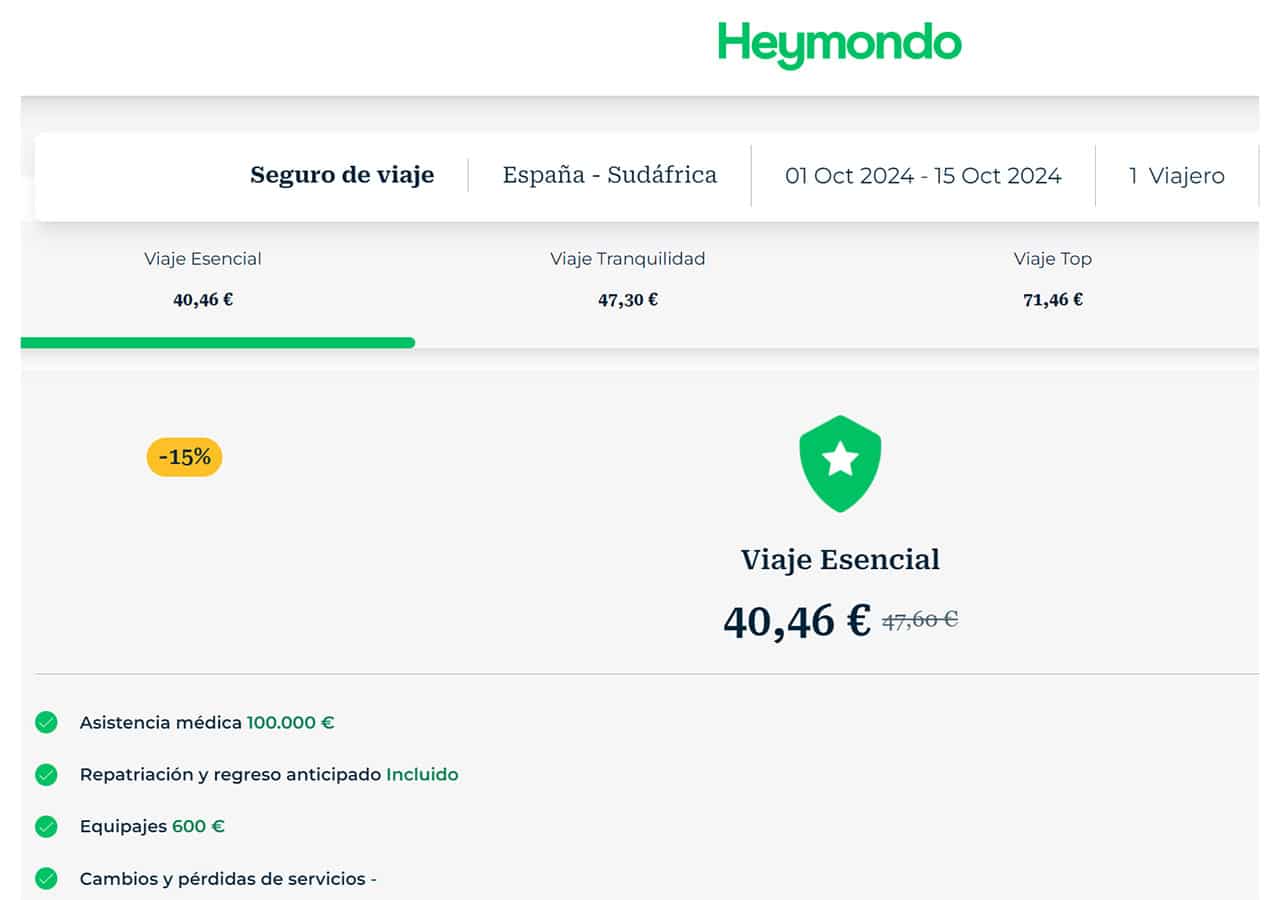
To give you an idea, from just €40 you already have a policy for two whole weeks to travel to South Africa with total peace of mind. Take a look here at the different coverages and don’t forget to include cancellation insurance because we are talking about a relatively expensive adventure to lose money in the event of a last-minute unforeseen event that leaves you stranded.
- Take advantage of the 5% discount on Heymondo travel insurance for being a reader of this blog. And if you also travel as a family, another 15% extra discount is added, that is, a massive 20% discount.
Where to stay in South Africa
The hotel offer in this destination is very wide and you can find quite cheap options with good value for money. To give you an idea, on average we paid €81 a night for 5 people, two adults, two children, and a baby, always sleeping in houses with a kitchen, not in hotel rooms, and almost always with a garden and barbecue.

And that average is higher because the prices for sleeping inside the national parks and reserves are higher, but it is well worth it. If there are only two of you, the bill drops considerably and it is easy to find where to sleep for €50 or less.
In the case of Kruger National Park, I recommend booking as far in advance as possible to find accommodation in the camps you want. Some of the most famous ones like Satara fill up months in advance. You can check availability and book on the official SANParks website. However, if you run out of space, you can always find private options inside, but very expensive, or sleep outside near the gates.

In my case, during the four-week trip through South Africa with children I combined cabins and self-catering accommodations with home exchange. With this last option, I was able to sleep for free for 12 nights. If you haven’t tried this option yet, here I tell you in detail how home exchange works specifically with the platform I use which is HomeExchange.
In case it’s helpful, here is the list of accommodations where I stayed, all with a kitchen:
- Dullstroom: Misty Cottage House with garden, barbecue, two bedrooms.
- Hoedspruit: Exchange house in the middle of the savannah with a communal pool.
- Kruger National Park: Camps of Satara, Skukuza and Lower Sabie in two-bedroom family cabins.
- Hlane National Park (Eswatini): Ndlovu Camp Family cabin inside the national park next to a waterhole where rhinos drink. There is no electricity, so at night you will light your way with lanterns. Essential!
- Pongola Game Reserve: AfriCamps at White Elephant Very special glamping tent with barbecue, private jacuzzi, and communal pool.
- St. Lucia: Exchange house with garden, private pool, and trampoline.
- Addo: Avoca River Cabins Room with living room, bathroom, and shared kitchen. Pool.
- Stormsriver: Forest Nest Large house with a big garden, BBQ, and three bedrooms.
- Tsitsikamma National Park: StormsRiver Mouth Rest Camp Wooden cabin with a balcony facing the ocean from where I saw a whale jumping.
- Mossel Bay: Flower Box Cottage ground floor apartment with two bedrooms in the city.
- Swellendam: Blue Mountain Farmhouse Three-bedroom house with a garden on a farm with a pool and trampoline.
- De Hoop Nature Reserve: De Hoop Collection Optal House Beautiful country house where you wake up surrounded by zebras and elands. Shared swimming pool.
- Hermanus: Exchange house with courtyard and BBQ near the beach.
- Cape Town: Exchange house with garden and views of Table Mountain and Lion’s Head.
If you want to know more details about all these accommodations, take a look at the article ‘Hotels in South Africa’.
Safari in South Africa

Possibly, one of the motivations that made you think of this destination is to see animals in the wild. The entire country is filled with national parks and private reserves where wild fauna is the protagonist. One of the positive points of South Africa is that, additionally, in several of them you can go on safari with your own car without the need to go with a guide or in a group. A whole adventure that I cannot stop recommending.
I already did it many years ago during my route through Namibia and Botswana, but repeating the experience now with my children has been very special.
Kruger National Park
Without a doubt, the crown jewel is the Kruger National Park, one of the most important wildlife sanctuaries in the world. Here you can see from your own car the Big Five—lion, elephant, leopard, rhinoceros, and buffalo—and thousands more animals in their natural habitat.
Besides driving yourself, I recommend booking a safari (game drive) at sunrise or sunset. You can book it either on the website or directly at the camps. You will go with a guide in a shared truck with other travelers for around three hours.

A guided safari in Kruger costs between 280 and 360 rands, which is more or less between €15 and €20. It is worth it because it is the only way to drive outside the camp when the gates are already closed. Additionally, sometimes they will take you to areas restricted to the general public. If you are going to travel to South Africa with children, you should know that children under 6 years old are not allowed on these safaris.
If you can, I recommend spending at least three nights sleeping inside Kruger Park. As I mentioned before, book as far in advance as possible to find space in the camps that interest you most.
Other parks and reserves where to see animals in South Africa
Although Kruger is the crown jewel, there are many more options for spotting wildlife. Note down parks like Addo to see plenty of elephants, Isimangaliso Wetland Park where the leopard lives, or Hluhluwe-Imfolozi and Pilanesberg to see the Big Five. If you feel like crossing into neighboring Eswatini, formerly Swaziland, Hlane Royal National Park is perfect for seeing rhinos.
- If you have few days, from Johannesburg, you can take this safari to Pilanesberg and Sun City.
But wait, there is life beyond lions. Take note of special places like the De Hoop Nature Reserve where you can see from elands, zebras, and porcupines to sea lions and whales very close to a beach of giant dunes.

Did you know you can see penguins in South Africa? Take note of these spots: Boulders Beach on the Cape Peninsula and the Stony Point Nature Reserve in Betty’s Bay.
Wild Card, the annual pass to enter national parks
To enter the national parks, you have to pay an entry fee that varies from one to another and is multiplied by the number of days you stay inside. You can save money by buying the Wild Card, a tourist card that gives you unlimited access for one year to all national parks managed by SANParks, as well as Hlane Park in neighboring Eswatini.
The million-dollar question is whether the Wild Card is worth it. It depends; you just have to do the math. But if you are going to spend several days inside Kruger, the most expensive of all, and you plan to visit a few others, it will surely pay off. Here is the link to the official Wild Card website where you will see that as of December 2022, an individual pass costs around €192, a couple’s pass €299, and a family pass €358 at the current exchange rate.
When calculating, if you are traveling with children, keep in mind that they pay entrance fees to the parks from the age of two.
- You might be interested in reading: All about the Wild Card.
Internet Connection
To have Internet access during your trip to South Africa, the most convenient and cheapest option is to buy a SIM card at the airport itself. To give you an idea of prices, I’ll tell you what it costs with the operator Vodacom, which offered the best rates. The cheapest was 20 GB for 14 days for 185 rands, about €10, and the most expensive was 100 GB for 30 days for 999 rands, about €54.
In my case, I opted for the 20GB card for 30 days for 599 rands, about €32. The prices are very good if you compare them with other options such as buying the card from Spain on websites like Hola Fly, where the cheapest was €47 for 6 GB for 15 days.
In certain areas, you may not have internet access or it may be excessively slow. It happened to me, for example, inside Kruger and in other reserves or parks far from ‘civilization’.
Power cuts, a problem in South Africa to keep in mind
If you are going to travel to South Africa, you should know that the country is currently going through a major energy crisis. The system, dominated by coal-fired power plants, has become obsolete in the face of population and industrial growth, and breakdowns in ancient infrastructure are a daily occurrence.

Faced with this serious problem, the only solution so far from Eskom, the state electricity company, is to perform scheduled and rotating power cuts to avoid collapse.
How will it affect you? This will depend on the area and the time you are there, as well as whether your accommodation has a generator or not. That’s why when you pack your suitcase, don’t forget things like a headlamp, a flashlight or solar lamp, extra batteries and an external charger.
Think that in places like Kruger or other parks, it is very likely that you will have to have dinner in the dark more than once. And think that if there is no electricity, you cannot cook unless you use cans and barbecues (that is not a problem because South Africa is the country of barbecues), you cannot pay by card, you cannot take a hot shower, nor charge your mobile phone and a few other inconveniences.
I recommend downloading one of these two applications: Eskom SePush or Load Shedding Notifier to know what time there will be a power cut according to your location. There are times when in the end the scheduled blackout does not happen, but other times it lasts many more hours than expected. Having information on when the electricity will go out will be very useful.
What and where to eat in South Africa
If for you part of the adventure is sitting at the table to savor local gastronomy, you will want to know what people eat in South Africa and where to do it. Some of the traditional dishes of South Africa are:
- Bobotie: spiced minced meat pie with gratin egg on top.
- Boerewors: sausages made in a spiral to be grilled on the barbecue (the barbecue is almost a religion here).
- Vetkoek: a tasty snack of fried dough somewhere between a turnover and a sandwich filled with meat.
- Pap: This simple white corn porridge is the accompaniment to almost any dish. It is also eaten for breakfast with honey.
- Biltong: strips of dried meat halfway between jerky and fuet (relatively speaking) with many varieties. There are shops dedicated solely to selling biltong.

During the almost 4 weeks of traveling through South Africa, we found it very difficult to find restaurants serving local food beyond sausages and biltong. However, in coastal areas, I recommend trying the fresh fish, which is usually prepared fried and is delicious.
At the end of the trip, thanks to the recommendation of my host in Cape Town, I discovered the restaurant Seven Colors where for very little money you can taste home-cooked dishes with all the flavor of authentic South African cuisine. It is on the first floor of the V&A Food Market, in the V&A Waterfront entertainment area. Go early because it is a small stall and chef Nolu Dube-Cel cooks a limited amount of food per day.
In St. Lucia, for example, I recommend two restaurants. At Reef & Dune, I tried the bobotie which was delicious, and at the seafood restaurant John Dory’s a very tasty varied fish platter. Both have a children’s area if you are going with kids, the first even has an indoor playroom and a trampoline ideal for rainy days.
In Mossel Bay, take note of the Krotoa cafeteria for breakfast, which in addition to eggs Benedict also has the classic pap with honey. To dine on an authentic South African fish barbecue and also listen to live music while the children play in the children’s area on a real boat, you must go to the curious restaurant Anchor Viking.
Excursions to do in South Africa
Although I will write a detailed article on proposals for things to do in South Africa and places to see, here are some excursions for those who prefer to have everything easy and be accompanied by a guide. I haven’t tried them because I did everything on my own, but they look good:
- Private tour of the Cape Peninsula
- Private tour of Cape Town and Table Mountain and if you want to complete it with Robben Island.
- Excursion to Cape Agulhas
- Paragliding flight over Cape Town
- Tour of Johannesburg and Soweto
- Excursion to Pretoria
- Private tour to the Stellenbosch vineyards
Keep reading about South Africa:
Travel to South Africa: practical guide
Hotels in South Africa
What to see in Cape Town
Guide to visiting Table Mountain
The best day trips from Cape Town
Visiting the Cape of Good Hope
What to see on the Panorama Route
Wild Card, is it worth it?
South Africa with kids
10 restaurants in South Africa to go with kids
Guide to traveling to Eswatini
Hlane National Park
Hermanus, the paradise of whales
- Are you thinking about traveling to South Africa with children? I can help you organize your tailor-made adventure through my personalized consulting service designed exclusively for families. Write to me at deilusionarecuerdo@gmail.com
* This article includes affiliate links. If you book something through them, it costs you the same, but you help me continue creating interesting travel content.


