

You learn from mistakes. After traveling to Israel, I can say with total conviction: do not judge a country before knowing it. Far gone is the idea that a trip to the Holy Land is only a destination for religious tourism, because the small country of Israel hides an incredible diversity of settings, proposals, and options to satisfy all types of travelers. When putting together your route thinking about what to see in Israel, do not focus only on the main Israel cities like Tel Aviv or Jerusalem, but also on unique landscapes like the Dead Sea or Makhtesh Ramon.
What to see in Israel in a week
- Before organizing the route through Israel, the most important thing is that you hire good travel insurance to travel with the peace of mind of knowing that you are well covered against any problem, whether health-related, with luggage, theft, or a last-minute cancellation. At Mondo you now have a 5% discount on your travel insurance for being a reader of this blog.
If you are thinking about traveling to Israel, you will discover that there are so many places to visit that it is difficult to choose without always leaving something interesting out of the journey. In my case, I followed this 7-day itinerary through Israel on my own, which did not disappoint me at all, although as always, it can be improved. My trip to the Holy Land is now in my drawer of memories forever, even though I couldn’t, for example, go to Eilat or the Red Sea.
I leave you the map of Israel in which you can see my route with what to see in Israel in a week to inspire you when setting up yours.
In my case, it was an independent trip with a rental car, but if you prefer to go on an organized trip, with the company of a guide who will explain everything to you in Spanish and without having to worry about anything else, a good option very similar to my itinerary is this 8-day tour through Israel.
Day 1: Tel Aviv – Caesarea – Acre – Tiberias
The arrival in Israel was not exactly idyllic. The plane landed even before dawn at Ben Gurion International Airport in Tel Aviv under an incredible downpour that seemed set to spoil the plans. However, after picking up the car at the terminal itself, overcoming a historic traffic jam and driving in the rain along the Mediterranean Sea coast, the sky gave a break just as I stopped in front of the ancient Roman aqueduct on the beach shortly before the entrance to Caesarea National Park.

If you like history, archaeology, and the sea you will have arrived at your own paradise and you have to thank Herod himself who built this Roman city back in the 1st century BC. Today, walking through its ruins among seagulls and waves is a highly recommended delight that will take you from the port to the hippodrome, the baths, and the amphitheater.

Continuing north, Haifa was left unseen because the next stop was the coastal city of Acre, included in the route not because Alexander the Great, Marco Polo, and even Napoleon passed through its port, but because it is the only city so far that is two in one. Underground, an entire authentic Crusader city is hidden with its secret tunnels that are worth exploring with a guide.
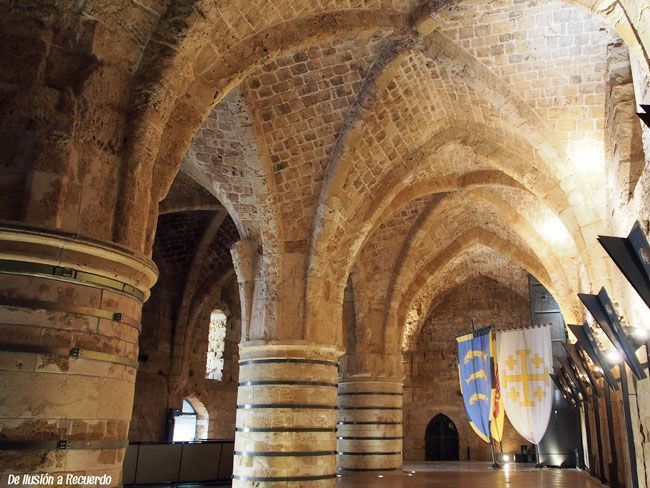
And on the surface, the current city buzzes with its narrow streets full of life where Arabs and Jews live together in apparent harmony, where it is possible to relax in a hammam, eat fresh fish at the port, lose yourself in the souk, or dream of sleeping among cotton clouds. Certainly, Acre was a pleasant surprise, a gem to see in Israel beyond the famous Jerusalem and Tel Aviv.

- If you don’t have a car, a good option could be this excursion to Caesarea, Haifa, Acre, and Rosh Hanikra from Tel Aviv.
After an intense day, there is no time or light left to get to Safed, so it only remains to sleep to recharge at the idyllic The Scots Hotel next to the immense Lake Tiberias that there was no time to investigate.
Day 2: Tiberias – Nazareth – St. George’s Monastery – Dead Sea
On the way to the Dead Sea there is much to see so there is no time to lose. The first stop is Nazareth which, besides having an undeniable religious weight, today is the most important Arab city in Israel. The most relevant site, besides a winding cobbled old town, is the Basilica of the Annunciation. Its modernist architecture is a very pleasant surprise, as are some curious mosaics in the courtyard representing the image of the Virgin with the baby Jesus in the most diverse countries you can imagine, a curious way to travel the world through this icon.

- If you are traveling to Israel on your own, but don’t have transportation, you can visit this area from Jerusalem with the excursion to Nazareth, Tiberias, and Galilee.
Following the route towards the Dead Sea, you have a stop that, in my view, is very much worth it. In the middle of nowhere, not far from Jericho and the refugee camps of the West Bank, the St. George’s Monastery appears carved into the rock, defying vertigo hanging in the middle of a canyon. Despite finding it already closed due to the schedule, just the views and the walk to go down there on foot are well worth the stop.

Ending the day driving along the shores of the famous Dead Sea is the perfect end point for the second day in this surprising country. Left behind was the Qumran National Park where scrolls and papyri were found that make up the oldest known manuscripts of the Bible. In my case, I’ll take the desert landscapes of the road, the force of the water in an improvised rain waterfall down the mountain, and this delicious sunset.

Day 3: Ein Gedi – Sodom – Dead Sea
The day arrives to discover the meaning of the word oasis. In the middle of the harsh Judean Desert, between two canyons, lies Ein Gedi, a nature reserve where you can go trekking to discover pools, small waterfalls, and surprising vegetation along the way to escape the heat and, with luck, encounter desert wildlife.

One of the most attractive places to see in Israel is, without a doubt, the Dead Sea. You will be surprised to find corners with emerald green waters that for a moment will play a trick on your retina, making it believe it’s in the Caribbean and not in Israel.

After testing the famous buoyancy in the waters of the Dead Sea (don’t even think about putting your head in or getting your lips wet, you’ve been warned), there’s nothing better than releasing some adrenaline with an incredible guided 4×4 route through Mount Sodom. A 100% recommended experience where you learn a lot of things from the great professional Barak Horwitz, you’ll be able to take incredible photos, and you’ll drive through places that look like another planet. Don’t hesitate to contact me if you want his contact info.

Day 4: Masada – Avdat – Mitzpe Ramon – Jerusalem
An early start isn’t so bad when the goal is worth it. In this case, watching the sunrise from the top of the Masada fortress is the best reward. You have to arrive while it’s still dark and walk up the famous Snake Path that winds uphill to take you to the top of this incredible plateau where a handful of Jews resisted the Roman siege, although that’s a story for another time. On the way back, you can save yourself the walk by taking the cable car down and calmly admire the views with the Dead Sea and Jordan in the background.

- If you’re going without a car, a good option is to book this excursion to Masada and the Dead Sea from Jerusalem.
It’s time to say goodbye to the Dead Sea to drive all day to Jerusalem, but taking a small detour for some points of interest. The first is in the middle of the Negev Desert, on a high hill where today the ruins of the ancient city of Avdat are located, which was a mandatory stop for Nabataean caravans traveling from Petra to the Mediterranean in the 3rd century B.C.

Without leaving the desert, you reach one of Israel’s most fascinating places which, interestingly, is not usually on tourist itineraries. It is the town of Mitzpe Ramon, the best viewpoint for Makhtesh Ramon, Israel’s grand canyon, where the earth opens into an immense gap 40 kilometers long and up to eight wide. My recommendation is to spend at least one night in this town to calmly explore this massive crater that offers, for example, interesting treks to discover spectacular lunar landscapes. However, in this case, we had to continue towards Jerusalem to sleep there.

Days 5 and 6: Jerusalem
And finally the itinerary leads to the inevitable Jerusalem where two full days don’t seem like enough for everything, but even so, it’s time to make the most of the holy city. Asking yourself what to see in Israel and not thinking of Jerusalem is almost a crime.
A guided tour helps you get a very good idea of everything there is to cover, from the Mount of Olives to the Old City with its different neighborhoods, the Temple Mount where the Dome of the Rock is the undisputed protagonist, the famous Western Wall and its underground tunnels, the Church of the Holy Sepulchre…
Take a look at this guided tour of Jerusalem which is very comprehensive because, in addition to everything mentioned above, it will also take you to a very interesting place like the Holocaust Museum with admission included (except on Saturdays).

Once you have that general overview, my recommendation is to lose yourself in its streets without any rush to observe the contrasts of its people, to listen to Jerusalem’s soundtrack, to breathe in the atmosphere of the city, returning at different times to the place that captivated you to see how it changes throughout the day and feeling free of prejudice to choose the Jerusalem you like best.

Don’t forget to visit Mahane Yehuda, Jerusalem’s most famous market to immerse yourself in a feast where smells and colors fight to stand out among the stalls of sweets, fish, vegetables, cheeses… An essential place to sit without blinking and watch the life of Israelis pass before your eyes. Don’t even think about going on a Friday afternoon or a Saturday because you will find it closed due to shabbat, however visiting it on Friday morning or Thursday afternoon ensures a special hustle and bustle.

At night there are also things to do in the city and one of the most recommended is the night show at the Tower of David next to the Jaffa Gate. An incredible game of lights and outdoor projections that recreates the history of the city in a privileged setting, the ancient medieval fortress that today houses the Jerusalem History Museum.
Day 7: Tel Aviv
The route ends with a brutal contrast, from the holy city where tradition and religion go hand in hand, to the city that never sleeps full of leisure offers, freedom and golden Mediterranean beach sand. Tel Aviv is proud of its youth and its sly impudence, showing its Bauhaus architecture among skyscrapers, its cafes on boulevards lit by a coveted sun and a bustling social, cultural and artistic life that make it the unruly sister of Jerusalem.

However, you don’t have to scratch hard to remember that you are still in Israel; just get closer to the Old City of Jaffa. Its cobbled streets invite you to get lost and be surprised by art galleries, museums, mosques and an Arabic air between traditional and bohemian that captivates. The ideal is to finish at the charming port, one of the oldest in the world, and if it’s at sunset even better because at those hours it offers the best views of the city. Watching the sunset in Jaffa is undoubtedly a basic thing to do in Tel Aviv.
- A good option to take the pulse of the city, get your bearings and learn about its history is to take a guided tour of Tel Aviv in Spanish.

If you would rather go on an organised trip
I did the route you have just read about independently, but you can do a very similar one with everything arranged for you. If you are the kind of traveller who likes not having to worry about a thing, I recommend this 8-day tour of the best of Israel. You will travel with a Spanish-speaking guide, with transfers and excursions included, so all that is left for you to do is enjoy it.
What to do in Israel
Don’t get overwhelmed with what to see in Israel and spend some time deciding what to do in Israel. Although almost better ask what you can’t do. If something surprised me about this small country, it’s all the little destinations it hides: beach, mountain, adventure, religious, relaxation, sports destinations…
You can float in the Dead Sea and enjoy the benefits of these waters in spas and relaxing treatments that will leave you like new. If you prefer the beach you will have plenty to choose from along the kilometers of coastline of sunny Tel Aviv where you have a thousand and one options for fun.
In case history is your thing, welcome to the Holy Land which exudes history in every corner and whose stones will tell you of invasions, empires and conquests. Lovers of archaeology have plenty to do visiting ruins and sites. For those of you into geology you will enjoy yourself immensely in the Makhtesh Ramon crater or in the Timna National Park where erosion has drawn a brutal landscape.
Undoubtedly, religious tourism has its ideal destination here to follow in the footsteps of Jesus and visit the settings of the holy scriptures.

But if active tourism is your thing, you’ve also come to the right place because in Israel you can dive in the Red Sea (an essential place to see in Israel that I missed out on), go trekking through landscapes typical of another planet, release adrenaline on 4×4 routes, practice cycling among canyons in the desert, even go rafting on the Jordan River and skiing on Mount Hermon.
Where to stay in Israel:
In this case, the accommodations for the trip to Israel were exceptional, very exceptional thanks to the invitation from Israel Tourism. Obviously they are all highly recommended as long as your budget allows. Anyway, I have looked for another more economical option with a good quality-price ratio for each place. To get better prices, I recommend booking as early as possible because it is a trip that people plan well in advance.
-Where to stay in Tiberias: The only night I spent there was at the delightful The Scots Hotel, a place with history with beautiful gardens with views over the Sea of Galilee, a breakfast fit for kings and the curious The Quiet Room among lemon trees where you can hide to enjoy the silence and read in its small library
Cheaper option: Lake Mansion Apartment. House with kitchen with good reviews.

-Where to stay at the Dead Sea: I was lucky enough to stay at the luxurious and modern Herods Dead Sea Hotel which has a great private beach and a spa where you can test your buoyancy and enjoy all the benefits of these salty waters.
Cheaper option: House of Art. You won’t be on the beach, but you will have a kitchen.

–Where to stay in Jerusalem: The nights in Jerusalem were at the Hotel Inbal which has everything necessary for you to feel luxurious, including a spa, a pool and the possibility of taking bicycles to ride through the city.
Cheaper option: The Post Hostel Jerusalem offers double rooms with bathroom and shared kitchen.
-Where to stay in Tel Aviv: The last night in Israel I spent at the Crowne Plaza Tel Aviv Beach which unfortunately there was hardly any time to enjoy, but which was great right on the beachfront.
Cheapest option: The Spot Hostel It has very cool common areas and rents bikes.
How to get around Israel
Depending on how you plan to travel to Israel, it will pay off to choose one way or another of getting around the country. If you are going for a few days and are going to focus, for example, on Jerusalem and its surroundings, without making long trips, perhaps the most convenient option is to use public transport. The bus network is the best solution because, although I didn’t try it, I have been assured that it works quite well within the holy city, for example, and has good intercity connections to reach even places like the Dead Sea.

But if you are considering a route similar to the one I have presented here, the best option is a rental car which gives you total freedom of movement to get around the map of Israel. In this case, after a lot of research and comparing prices on AutoEurope, I went with Budget which has drop-off and pick-up at Tel Aviv’s Ben Gurion International Airport.

Keep in mind that you will not be allowed to enter the Palestinian Territories, so if you decide to do so at your own risk, remember that insurance will not cover you in case anything happens on those roads. On the other hand, if you take any toll road such as Route 6, keep in mind that the amount, around 32 shekels, will be paid upon return through the charge made by your rental company.
How much it costs to travel around Israel
Prices in Israel are more or less similar to Spain, so don’t expect to get by on a budget as small as the one you would have in Southeast Asia. Here is the cost of some things so you can get an idea of the expense. As of June 2022, the exchange rate means that 1 € = 3.63 NIS (new shekel).
Gasoline: It was a 7-day car route through Israel and the total fuel cost was about 128 euros.
Food: Obviously, this section is very subjective because it depends a lot on whether you go for sandwiches or opt for restaurants. In this case, it was a hybrid between both options to try to economize, which resulted in an expense of about 240 € for the whole week for two people. A Coca-Cola is around 8 shekels, about 2 €, a fresh orange and pomegranate juice for 15 shekels and a falafel, for example, for 15 shekels, about 3.5 €

Taxi: For example, the taxi ride in Jerusalem from the Old City to the Mahane Yehuda market was 42 NIS, about 10 €
Entrance fees: To help you prepare your wallet, here are some examples of what it costs to access some attractions in Israel. Entering the archaeological ruins of Caesarea is 40 NIS, almost 10 €, spending the day at the Ein Gedi oasis for trekking is 29 NIS, while visiting the incredible Masada fortress was 44 NIS, to which you have to add 29 NIS for a cable car ride—mind you, one way, as the way up was on foot.
Is travel insurance necessary for Israel?
I always travel with insurance, even to Europe. For me, it is highly recommended to take out travel insurance that gives you the peace of mind of feeling covered because you have a company looking out for you.

In case of an accident or health problem, being able to count on someone who can tell you which hospital or medical center to go to, where it is located, and how to proceed to get medical attention is essential. Especially in a country like Israel, where the language can be a problem at a delicate moment when nerves don’t help.
In addition, of course, to solving cancellation or lost luggage problems… In my case, I travel with Mondo, which also features a 24-hour medical chat in its app that I have unfortunately had to use, and I can assure you it works like a charm. This extra can save you more than one visit to a medical center or hospital.
Now, you can benefit from a 5% discount on your Mondo travel insurance for your next trip for being a reader of this blog.
How to have an Internet connection
Nowadays, traveling without being connected to the Internet would make logistics much more complicated. Looking for a place to eat, using Google Maps to reach your next destination, checking museum hours, and, of course, staying in touch with your loved ones at all times.

You should know that the cost of roaming in Israel costs an arm and a leg, and you could be in for unpleasant surprises. Nowadays, the most convenient thing, as long as your mobile phone allows it, is to buy an eSIM card that allows you to have data in Israel on your mobile without having to physically change cards. You just have to scan a QR code and, as soon as you land, you can let your family know you’ve arrived. In addition, you’ll keep your WhatsApp number with your contacts and you won’t risk losing your original card.
Within the eSIM with data option, here are two choices so you can choose the one that best suits you based on the number of days you are traveling to Israel and the volume of data you need.
On one hand, you can get a HolaFly card, which I see two important advantages for: One is that it has unlimited data, for example 7 days for 27€, and the other is that it has 24-hour support in Spanish for any incident or doubt you may have. Take a look here at the HolaFly prices in Israel depending on the days and take advantage of the 5% discount with the code DEILUSIONARECUERDO
Another option is to get a limited data eSIM card with different combinations to choose from. To compare with the HolaFly one, this one would cost you about 22€ for 7 days at a rate of 1GB per day. In the previous link, you will see the different options according to your needs.
Where to eat in Israel:
I admit that I liked the gastronomy of Israel, but it did not completely captivate me, perhaps because it lacks its own identity as it is like a mix of many influences: Arabic, Jewish, Middle Eastern, Mediterranean cuisine… Here are some restaurants in Israel that I liked and I do dare to recommend:
Where to eat in Acre
Among the narrow streets of the souk is Hummus Said, a small place that I can’t tell you exactly which street it is on, but you will recognize it because there is always a queue at the door and it has its name above the door. In this modest and small bar they prepare a hummus that you can take away in pita bread and mixed with chickpeas that was delicious and very cheap, with a drink included.

Where to eat in Jerusalem
In the Holy City there is a wide range of restaurants for all tastes, so wander around and discover your favorites. Within the Old City, in the Christian quarter, I recommend having dinner at Amigo Emil at Aqabat al- Khanqah st because the food is very good, the place with stone walls has hundreds of years of history and because its owner is charming and if you meet him he will tell you a lot of curiosities. A very complete and very tasty dinner at a good price.

In the crowded streets of Mahane Yehuda market, in the tiny Souq HaYorekrom square, you will find the restaurant Azura whose sign is hard to find. Be patient to get a table because then you will be able to taste quite tasty dishes and they boast of having the best hummus in the city. A statement that for me is not true because I definitely prefer the one I tried on Yoel Moshe Salomon Street in the small bar called Nachla 16 where they serve a hearty and delicious homemade hummus with meat that seemed perfect to me.
I finally missed out on trying one of the most typical foods of the Middle East that you found everywhere in Israel. Halva (in the photo) is a sweet block made with a tahini paste and that can contain sesame, seeds, pistachios, dates, honey… It was very common to find it at breakfast, in restaurants and markets throughout the country.

When to travel to Israel
If you don’t want to be hot, it’s better to rule out the option of traveling to Israel during the summer months because the heat will be unbearable, you won’t want to get out of the water at the beaches in Tel Aviv, and prices rise as much as the temperatures.
Specifically, I took this one-week trip to Israel in November and it was certainly a success. If you want to know what is the best time to travel to Israel, I would tell you that the best months to see the country would be from late September to November and also between March and June. Winter can be a bit cold, especially in the north, although in the southern area of Eilat you will be fine.
—
Do you miss anything? I hope I have helped you discover at least part of all there is to see in Israel and encouraged you to travel to Israel on your own.
More articles about Israel:
What to see in Israel in one week
Tel Aviv, 10 things to enjoy it
4x4 route through Mount Sodom
Mitzpe Ramon, the guardian of the abyss
Things to do in Jerusalem during shabbat
Jerusalem, the holy city of sounds
*This article includes affiliate links. If you book something through them, it will cost you the same price, but you will help me maintain this blog with the small commission you generate.


