
Colombia with kids: 2024 Guide to planning your family trip
If you have come this far because you are doubting whether traveling to Colombia with kids is a good idea, I’ll clear up that doubt right now: yes, it is. And in case you were already sure and are looking for practical information to organize your adventure through Colombia with children, as well as plans to do with the little ones there, stay tuned because you’ll be interested.
After a month traveling through Colombia with my three children aged 2, 5, and 6, I’ll tell you everything you need to organize yourself. If after everything, you still have questions, leave me a comment at the end and I will try to help you. In addition, I have a through which I can organize your trip to Colombia with kids independently and tailored to your needs.
Is going to Colombia with kids a good idea?

You already know the answer because I said it at the beginning, but let’s argue this point: yes, it is a good idea to travel to Colombia with children.
In the first place, this country is an absolute beauty and it would be a crime if your children didn’t enjoy its huge variety of landscapes each one more different than the last. Here nature is queen, whether in the form of crystal-clear beaches and islands, jungle, desert, or hills. If your little ones like to be outdoors, welcome to paradise to run and play everywhere with everything the environment offers, while also learning a lot of things. My children, for example, really enjoyed seeing animals in the wild and playing with other kids with whom there was no language barrier.
Secondly, the people of Colombia are its most precious asset because they are kind, helpful, calm and, in general, very fond of children. They will help you with everything they can, give your children a smile, and make them part of their conversations. All this will translate into your little ones and you feeling at home, far from the looks of disapproval that you do receive in some other destinations when your child screams or does something typical of their age. Therefore, you will enjoy the country more.

In third place, somewhat related to the previous point, children are more than welcome in Colombia, they think about them and that is very much appreciated. That is why you will see that in Colombia, families with young children have priority in almost all places, before joining a queue, ask because you will most likely skip it or there will be a specific line. Two good examples of this are the immigration process at the Bogota airport or the entrance to the Tayrona National Natural Park.
Another example that the little ones are welcome is that the reasonably priced children’s menu is very widespread and the portions are usually quite generous. Even so, of course, encourage them to try the Colombian gastronomy that they are going to love.
Fourthly, you won’t miss anything that you don’t have at hand in Spain, or in your country of origin. Yes, when you go to Colombia with children you’ll realize that there are also pediatric emergencies, diapers in the supermarket, children’s ibuprofen in pharmacies, high chairs in restaurants and anything else that comes to mind right now. And if they don’t have it, they will go out of their way to give you another option that solves your possible problem.
Is it safe to travel to Colombia with children?

One of the main questions that might be making you doubt whether or not to buy those plane tickets to go to Colombia as a family is that halo of insecurity that surrounds this country due to its history.
Banish the idea that they are going to rob you on any corner or that the guerrilla is going to kidnap you. Of course, you must maintain certain preventive measures to avoid possible scares, but be careful, just like in many other destinations or in some areas of large cities like Madrid or Barcelona. I had the same doubts before traveling to South Africa with children and I have come back with the same feeling: it is perfectly feasible to travel to Colombia with children without feeling fear and enjoying it to the fullest.
The reality cannot be hidden that indeed Colombia, like South Africa, is on the list of countries with the highest crime rates in the world, according to the UN study. But did you know that Mexico follows closely in positions and I don’t know any family that stops going there on vacation because it is dangerous? Yes, there are robberies, yes there are delicate areas to avoid, but I insist, as in many other places. And the specific problems of crime are not on the tourist routes.
During the 28 days that I was in Colombia with my small children, I felt not only safe, but also very well received and protected by its people. All those fears about insecurity immediately vanish. In general, we saw quite a lot of police presence, even military in some places.
The keys to traveling safely in Colombia with or without children are:
-
Common sense, nothing more.
-
Don’t give papaya. This is the expression that Colombians use to say that you should not go down the street with your mobile phone hanging, the camera in your hand, the shiny gold ring and the wallet coming out of your pocket. Try to go as unnoticed as possible considering that you are a tourist and no one can hide their tourist face.
- If you doubt where you can go or not, ask the locals because they are going to be kind and sincere. In our case, our hosts from the HomeExchange houses where we stayed were great allies, but do not hesitate to ask openly in the hotel where you stay or in the corresponding restaurant.
- Try not to go out at night and if you do, let it be to places that you know are safe. With the children, we didn’t usually go out to dinner, but we did in the old town of Santa Marta or in Medellín in the El Poblado area and there was no problem. But, for example, they did warn us not to walk at night through the La Candelaria neighborhood in Bogotá.
- If you travel by rental car around the city, it’s best to keep the doors locked and the window closed when you stop at traffic lights. In case you plan to take a specific route, check for example at the car rental office if it is safe and try not to take alternative paths. There are roads that it’s better to avoid, but most likely those are not in your route plan. We traveled by rental car from Santa Marta to Cartagena de Indias, passing through Barranquilla, and we felt super calm. We also took a car in Medellín to go to Guatapé and move around the city. The Coffee Region, for example, is super common for renting a car and this specific area is very peaceful and safe.

If you are going to visit the usual tourist circuits and follow these recommendations, normally everything will go well. Seriously, don’t stress about the safety issue, nor let it condition the trip. As I was saying, we felt super calm in Colombia, we never saw any violent incidents, nor did we feel intimidated. The most dangerous thing is that you won’t want to come back because you will fall in love with this country.
The only exception where I confess that this supposed danger did affect us was in Medellín where, for example, we decided to take off our wedding rings or hide our cash. In the rest of the country, we never did those things, nor did we stop taking photographs, they didn’t even cross our minds. This feeling of insecurity, which also coincided with the last three days of the trip, I admit was totally personal and the result of suggestion because it happened that several people spoke to us about how dangerous Medellín was. Nothing happened to us, nor did we see any difference compared to, for example, Bogotá, where we were totally relaxed, and later several Colombians we spoke with thought that the capital was more dangerous than Medellín.
Remember to take out a travel insurance for Switzerland. to travel peacefully knowing that you are well covered. I recommend including cancellation, so that if you have to cancel the trip you don’t lose the money from flights, hotels and reservations. I use Heymondo, which has a special policy for families with details such as 24-hour pediatric care, among others.
Now for being a reader of this blog you have the 20% discount if you travel as a familybooking from this link.
What I should take into account to go to Colombia with children

Now that I hope I have dispelled that fear of insecurity, I’ll tell you some tips and details that will come in handy when organizing a trip to Colombia with children.
Requirements for entering the country
If you are going to travel to Colombia from Spain, you only need a valid passport with a minimum validity of six months. Check in advance that your passport or your little ones’ doesn’t expire before those months to avoid problems when catching flights. If your origin is not Spain, check specifically if you need a visa to enter, as is the case for example with Egypt or Cuba.
The travel insurance is not an entry requirement, but it is recommended to take out a policy to be well covered whether for medical necessity, loss of luggage or many other circumstances. I, for example, had to use it in Bogotá because my 6-year-old son had a lot of coughing and difficulty breathing. I turned to Heymondo, who I always travel with, and after a while I already had an email with the exact address of the pediatric emergency room closest to our accommodation where they treated us great without having to pay anything.
Don’t forget to take a good travel insurance to be covered for any unforeseen event. I go with Heymondo, which includes video consultation and 24-hour medical chat. Don’t forget to add cancellation in case you have to cancel the trip.
Take advantage now of the 5% discount plus another15% extra if you travel as a family.whatever your travel dates are, as long as you book it from here.
Are vaccines needed to go to Colombia with children?
There are no mandatory vaccines to enter Colombia.
But very importantly, there are recommendations to follow depending on the areas you are going to visit. For example, the yellow fever vaccine is essential if your route includes, for example, Tayrona National Park, the Amazon or other specific areas. Tayrona is one of the places that is usually on the most common itineraries when traveling to Colombia, so it is very likely that you will have to get it
In my case, we did get the yellow fever vaccine because we were going with the children to Tayrona and the Orinoquía area (the adults already had it from before). Keep in mind that it is only one dose and is valid for life. To ensure its effectiveness, it must be administered at least 15 days before entering the risk area. In Madrid, in 2024, the yellow fever vaccine costs €19, which you have to pay before getting it; at the vaccination center itself, they give you the paperwork to go and pay for it. Specifically, my children did not have any kind of reaction. It can be administered from 9 months of age.
Additionally, keep in mind that Colombia has other tropical diseases such as dengue or zika. The latter is extremely relevant in case you are pregnant. Usually, children are also recommended to have the hepatitis A vaccine.
In case you plan on going to the Amazon, they will recommend taking pediatric malaria prophylaxis. They will give you the prescription and indicate the dose and when to start administering it before entering the risk area. This time we didn’t need it because it wasn’t on our route, but we did take it when we went to South Africa with children.

The most recommended thing is to make an appointment at a specialized traveler’s unit to find out about vaccines and the updated health situation of the specific areas you have in mind to visit. There, the specialized health professionals will be the ones to advise you based on your personal situation, your route, and the children’s medical history. Remember to bring their vaccination record.
In Madrid, there is the Traveling Child Unit which is located at the Hospital público de la Paz, on the ground floor of the children’s hospital. You can make an appointment by calling 91 727 72 01 and 91 727 16 44 between 08:00 and 14:00. Do some research, as there is surely something similar in your city as well. I recommend booking an appointment at least two months in advance of your departure date to tell them where and when you are traveling and to ensure you are seen at the right time. The consultation is free.
Other recommendations if you are going to Colombia with children
At the Child Traveler unit or at any vaccination center, they will also give you a series of recommendations to follow to avoid health complications. Surely, you already have many of them in mind, but it is always good to remember the most important ones.
-Preventing mosquito bites is very important.
Depending on the areas you visit and the time of year, it will be more or less simple. In our case, we went in February, and we were in mosquito-prone areas like Tayrona and Los Llanos, in the Orinoquía region, but honestly, it didn’t pose any problem except for a few isolated bites.
However, I did remove a tick from myself and we had some unidentified bites. Neither caused us any problems.
Try not to spend much time outdoors at dawn and dusk when mosquitoes are most problematic. And if you do, go well protected.
Pack in your suitcase long-sleeved clothing that covers the skin and, if possible, in light colors or white.
Don’t forget to bring a mosquito repellent with high DEET. From 12 months onwards you can apply repellent to your little one; before that, they recommend spraying a little on their clothes before putting them on and using mosquito nets. In the child traveler unit, for example, they recommended the repellent Goibi Xtreme Forte valid from 2 years old and specifically for malaria, dengue, and yellow fever areas.
It’s also not a bad idea to take a cream or gel to soothe potential bites.

-Protect them very well from the sun.
Remember that in Colombia the sun is very strong all year round, so it is essential to protect yourself very well from sun exposure to avoid burns. Additionally, in high-altitude areas like Bogotá, it hits even harder; I’m telling you from personal experience.
Take a small bottle of sunscreen for the first few days, but then I recommend buying another one there because they have them with SPF protection factors up to 100, even 100.
If you go to Colombia with children, you will surely visit some of the spectacular Caribbean beaches, so a good idea is to get some long-sleeved sun protection shirts to play in the sand and swim without risks.
–Drink bottled water
In large cities, the water is potable, and even so, in almost all the houses where we stayed, they had water purification filters. In Bogot and Medelln, we did refill our bottles with that filtered water. But in the rest of the country, it is advisable and safe to drink bottled water.
– Watch out for street food stalls
At the traveler’s child unit, they recommended that we do not eat at these stalls, but the thing is that in Colombia they are everywhere and have everything. For example, stalls with cut fruit, mango biche (the unripe mango with salt, lime, and pepper is delicious), all kinds of arepas, or grills are very common. If you are going to succumb to temptation—I did, I love them—at least avoid buying from those that are next to the roads because you will eat a good handful of pollution. Check that whoever handles the food at least wears gloves. Better not to consume fried foods because that oil is likely over-reused. Here, it’s about the risk you want to take.
–Accept that it will be complicated to travel 100% safely on public transport.
Personally, what I struggled with most was carrying the children many times without seat belts. If you move by taxi, Uber, or similar, it is very common for the rear belts not to work correctly or directly not be available. Additionally, we travel with three children, so at least one had to travel on an adult’s lap. Accustomed to taking them with child restraint systems and rear-facing, it was quite a challenge to travel like this, in our case for the first time, and we have traveled a lot.
The good thing is that in general, they drive at low speeds in Colombia, although they are quite chaotic at the wheel.
In case you take a rental car, it is not that easy to find available child safety seats, but always ask for them. Sometimes they will ask you to go pick it up at another office. If you are only traveling with one child, it will be easier for them to have it. The three times we rented a car in Colombia with the kids, we did it through DiscoverCars because it allowed you to choose the Localiza agency with good prices; it operates throughout the country, has car seats, and had been recommended to us.
Discount on your eSIM for Colombia
If you want to have an Internet connection and unlimited data on your mobile, take advantage of the 5% discount at HolaFly with the code: DEILUSIONARECUERDO.
If you don’t need unlimited data, check out the plans from SimLocal where until December 2nd you have a 10% discount by entering the discount code: RECUERDO
Plans in Colombia with children
As I told you at the beginning, Colombia with children is a great destination. Honestly, the little ones enjoyed all the plans we did even if they weren’t specifically for kids. There aren’t many parks with slides and swings in the traditional sense, but you still won’t lack ideas of things to do with them.
Here is a list of some of the plans to do in Colombia with children that my 6, 5, and 2-year-olds enjoyed the most, in case they serve as inspiration.
– Go on safari in Los Llanos

My children love animals, so the two-night stay we did in the La Aurora Reserve, in the Orinoquía, was one of the things they remember most when you ask them about the trip to Colombia. Despite being remote—you have to fly to Yopal and then drive for about 5 hours—it was a total success to include this area in the route. If your little ones have the souls of adventurers and explorers, they will love it. Additionally, if they are older and capable of waiting a long time and staying quiet, you can take a specific safari to spot the jaguars that inhabit the area.
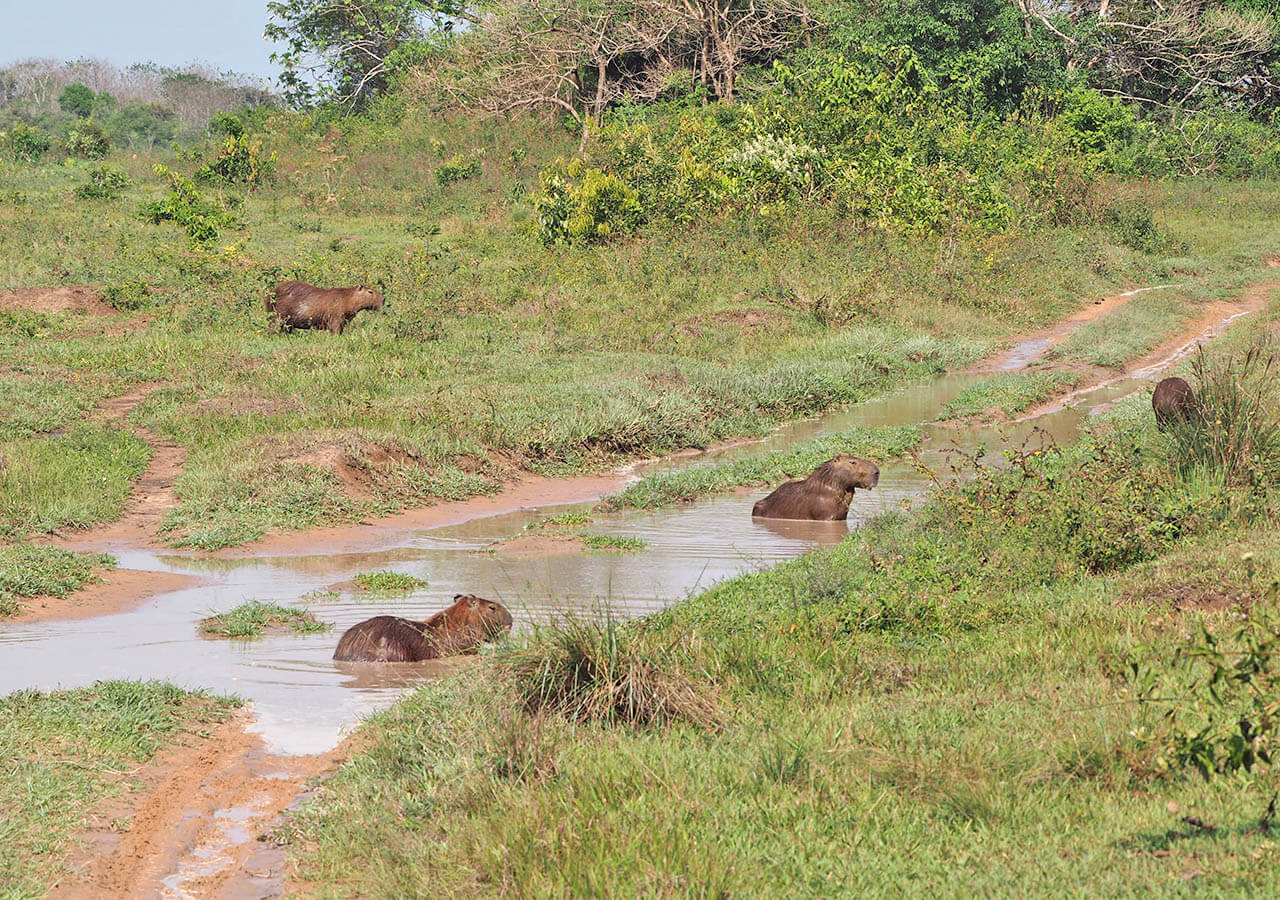
Navigating by canoe down the river among caimans and herons, trying to fish for piranhas, riding in a 4×4 for a safari surrounded by capybaras, searching for the giant anaconda, and following the trail of the giant anteater at dawn were unforgettable family plans.
-Climbing the Peñón de Guatapé

Another of the memories my eldest son talks about most was climbing to the top of this giant stone monolith, more than 200 meters high. In total, there are 708 steps—not suitable for people with vertigo—that take you to beautiful views that make the climb well worth the effort.
If you are going with a baby, take a baby carrier because the only way to reach the top of the Peñón de Guatapé is by the stairs. At the top, you have some souvenir stalls and the possibility of rewarding yourself with an ice cream or a drink after the effort.
Entrance in 2024 costs 25,000 pesos, but children up to 120 cm tall do not pay anything. Don’t worry, the climb with children is feasible, little by little, without rushing. My nearly 7-year-old son and I took only 20 minutes to go up with the necessary stops to drink water and take photos. Mind you, the steps are a bit high, but I saw smaller children climbing.
In addition to the Peñón, the town of Guatapé, famous for its original colorful baseboards (zócalos), is beautiful, and the kids had a great time playing on the stairs of the Plazoleta de Zócalo and in the small playground on the waterfront.
excursion to Guatapé which also includes the boat ride
What to do with children in Bogotá
Surely on your adventure through Colombia with children, you will pass through the country’s capital. We stayed for four nights and here are some of the plans we did with the kids and one that was left on the list, but perhaps you can do it.
-Visiting the Gold Museum of Bogotá
Funny enough, a plan that is not child-oriented at first glance was one of the things my kids liked most. Perhaps it was the stories told to them by the guide from Transfers Tours but they were very interested in the different gold pieces carved by the indigenous people; they took photos and the eldest even drew them in detail in his travel journal. The Gold Museum in Bogotá is free for children under 12; from then on it costs 5,000 pesos, although it is free on Sundays.
That same day, also with the guided tour from Transfers Tours, we went up to Monserrate hill, entered the Botero Museum, visited the old town of Bogotá and enjoyed the colorful La Candelaria neighborhood.
– Learning science through play at the Maloka museum
Maloka is the interactive science and technology museum of Bogotá and a very good plan to do with children in Colombia. It is not very big, but it does have many options. In addition to the permanent exhibitions where kids can touch and experiment, they offer very entertaining workshops and laboratories; some are included in the entrance fee and others, by age group, such as the small inventors’ robotics workshop that my children did, are paid for separately by purchasing them in person at the ticket office.

Dome cinema
– Play, play and play at the Ciudad de los Niños Park
After Maloka, we headed to this gigantic outdoor playground which has different areas with slides, climbing towers, water games, an immense sandpit, circuit… In total, it has five thematic play areas. A paradise where children can release plenty of energy and from where, I warn you, you will find it hard to take them away.
It opens from Tuesday to Sunday from 6:00 to 17:30 and is completely free. If it’s hot, take a change of clothes because there are water jets coming out of the ground for them to cool off. We found them closed. The Ciudad de los Niños Park is a fenced enclosure within the Salitre Recreational Sports Park.
– Visit the underground salt cathedral
The excursion to Zipaquirá to see the salt cathedral is another plan to do in Colombia with children. Going down into the depths of the earth, specifically to 180 meters, and discovering the crosses and treasures of this original underground church really caught their attention.
The visit to the cathedral lasts about two hours, although you can add extras like the option of becoming miners. We went again with Transfers Tours for an entire morning that also included getting to know the small town of Zipaquirá.
Keep in mind that you either take a rental car or you won’t be able to get here on your own by public transport. That is why booking the excursion to Zipaquirá is the most common way.
– Fun and culture at Jaime Duque Park
One of the plans with children in Colombia par excellence is visiting this sort of highly eclectic theme park that includes a lot of attractions, a zoo, a full-scale replica of the Taj Mahal among other monuments, trails, a medieval castle, a ship, a plane, museums, gardens… Everything you can imagine and more seems to have a place here.
Specifically, we didn’t get to go here because my oldest son needed to go to the emergency room, but the excursion to Jaime Duque Park was recommended to us as a must-do for spending the day as a family. This gigantic place is named after the famous Colombian aviator Jaime Duque.
– Mundo Aventura. Another idea to do in Colombia with children if you have several days in Bogotá is to go to the amusement park Mundo Aventura, but personally I think it doesn’t have anything that any other amusement park doesn’t have, and the country’s capital already has plenty of interesting places to explore.
Plans in the Coffee Axis with children
During our 28-day trip through Colombia with children, one of the destinations we enjoyed the most was the Coffee Axis where we stayed for five nights and which we explored for a few days on our own in a rental car and other days guided by the experience of the agency Hawah Travel which is a specialist in this area. Without a doubt, the Coffee Axis is one of the places that cannot be missed on a trip through Colombia as a family.
-Admiring the beauty of the Cocora Valley
Here, both adults and children enjoyed themselves to the fullest, so much so that after an initial guided visit to the Cocora Valley with Hawah Travel, we decided to return on our own for a second day to continue enjoying its landscapes and its calm.
The Wax Palm Forest is one of Colombia’s most representative landscapes and will leave the whole family open-mouthed. The children really enjoyed taking photos with the different spots set up for it, from animal figures, to large letters, a giant hand, a nest… And in addition to being amazed by the height of the wax palms, the country’s national tree, they had a blast playing at driving a willy (that’s the name of the off-road vehicles used as public transport) and seeing horses, sheep and even alpacas.

I would have loved to do the complete 12-kilometer circular trek to see the Cocora Valley from top to bottom and pass by the Hummingbird House, but the little ones weren’t in the mood to walk that much this time. But even doing just the short walk to the first viewpoint, we enjoyed it very much.
In 2024, the entrance to the Palm Forest (it is private property) costs 20,000 pesos from age 3. While there is no reduced price for children, in our case since we were with two children over that age, they only made us pay for one.
Currently, there are two private mini parks (before reaching the Palm Forest) where they have installed a multitude of photo spots like an ‘amusement park’: La Vida es Bella and Las Manos de Cocora. Both are on the access road and really catch children’s attention because of all the colorful paraphernalia and the references to Encanto, the Disney movie. We didn’t go in, but the price for each of them separately is 15,000 pesos.
-Look for the howler monkey in the Barbas Bremen Reserve
Even though in some places I read that children under 5 could not do the hiking trail that crosses part of the Barbas Bremen reserve to spot the howler monkey, I did it with a two-year-old toddler, my daughter who had just turned 5, and the eldest who was almost 7. And it was a success!
Thanks to Hawah Travel who trusted that the little ones were capable of walking for about three hours through this Andean tropical forest with jungle vibes and even keeping quiet to see the animals. We all loved the experience, adults and children alike, because we learned so much about nature with our guide Jerónimo, who was also very attentive to the children.

In addition to seeing the monkeys, we saw a pair of parrots in their nest. But even if we hadn’t found any animals (which isn’t easy), it’s worth just going into this beautiful and special ecosystem, waterfalls included.
Ideally, you should go with rain boots, but if you don’t have them, they lend them to you there. However, they didn’t have any for the smallest feet, so bring some old shoes that won’t be a tragedy if they get muddy. I recommend bringing a baby carrier if you’re going with a baby. We also used an auxiliary backpack in case the girl got tired or if there was a difficult step, and it came in handy for a small part of the route.
-Having fun at El Parque del Café
If you are looking for a 100% child-friendly plan in the Coffee Axis with children, this is going to El Parque del Café, a full-blown amusement park with some themed trails, a small interactive coffee museum, two cable cars, a train, and shows like the coffee show.
I would only go if you have several days in the area, because it’s still just another amusement park. Honestly, my kids had a great time and we spent the whole day between roller coasters and games. Bring a change of clothes because you will definitely get wet. El Parque del Café offers horseback rides around the premises, which are paid for separately; please do not collaborate with this animal exploitation, you will enjoy the park just the same.
You can visit it on your own if you have a rental car and save a few euros by buying tickets online in advance, or book a private excursion from Pereira or from Armenia
-Taking a dip in hot springs
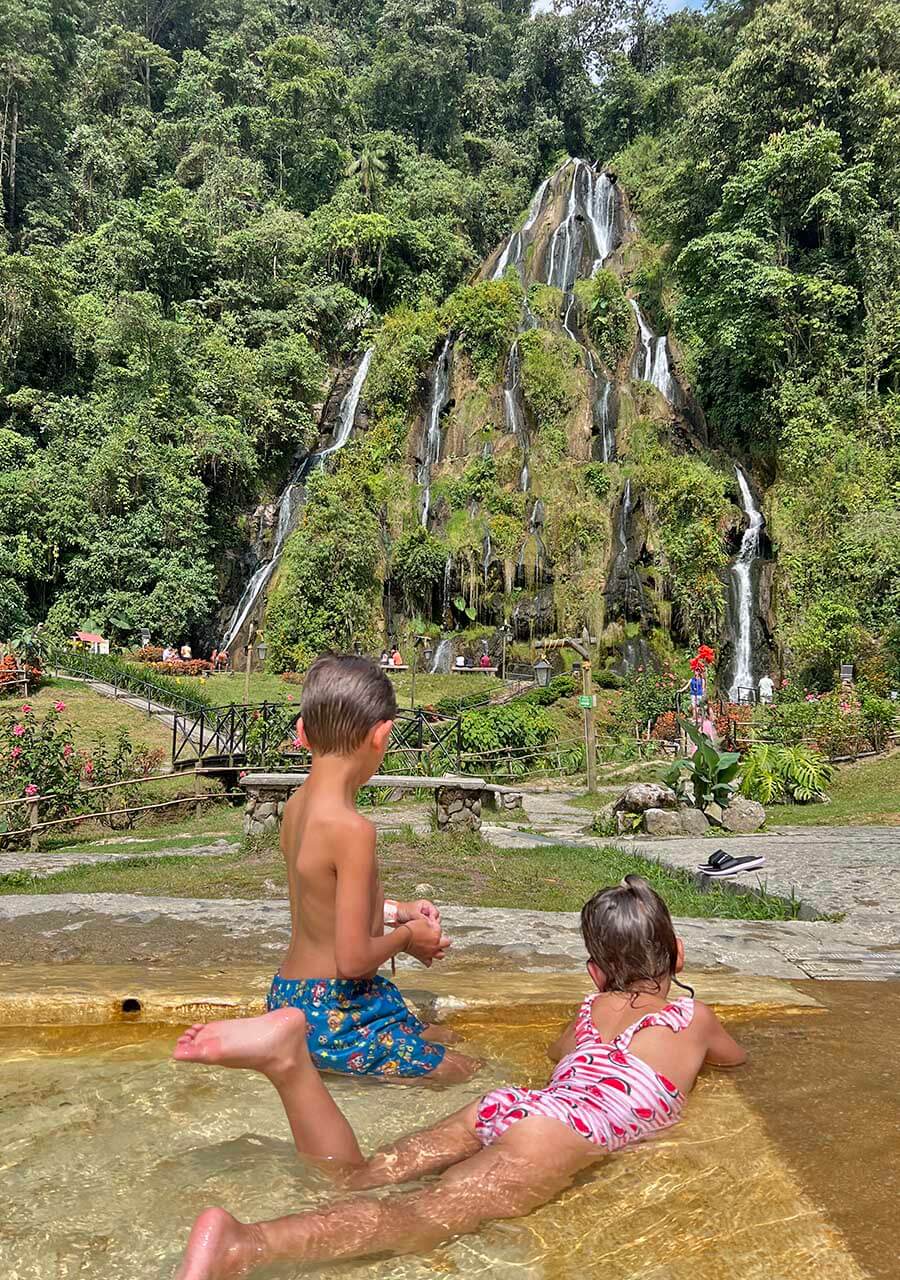
Bathing in the Santa Rosa de Cabal hot springs is another of my essential recommendations if you go to Colombia with children. They loved trying the warm water in the different thermal pools, splashing non-stop, looking for little frogs, and all in a beautiful natural setting under a waterfall where you can also bathe.
If you go on your own with your car, I recommend doing it during the week since tickets are cheaper, and buying them on the official website rather than at the ticket office to save money. Children under 90 cm tall enter for free and those between 90 cm and 1.20 m tall pay the child rate. There are three different shifts to access the spa: 6:30, 11:30, and 6:00 p.m.
private excursion to Termales Santa Rosa de Cabal
– Take them to visit a Coffee Farm
Even though the little ones obviously don’t drink coffee, they’re going to have a blast harvesting coffee with a basket tied to their waist. My kids had a lot of fun and learned many things. We went with Hawah Travel whose guide worked hard to motivate them and made the visit very enjoyable. We visited Finca Ocaso, one of the most famous ones, but there are many to choose from.
What to do in Colombia with children in the Caribbean
No trip to Colombia with children would be complete without spending a few days soaking in the Caribbean. In total, we spent ten days in this area, passing through Barranquilla, Santa Marta, Tayrona, Cartagena de Indias, Baru Island, and Isla Grande (Rosario Islands).
-Explore the Tayrona National Natural Park

To be honest, we hardly saw any children in the Tayrona National Natural Park, but we thought it was a great plan. You can go just for the day, but given the time it takes to get there and the entrance fees, I think it’s very worthwhile to spend at least one night inside to make the most of it.
The beach we liked best for the little ones was Piscina beach where we were twice, the day of arrival and all the following morning.
The little ones had a great time soaking, snorkeling and seeing monkeys in the trees. Plus, for them, it was an adventure sleeping inside the jungle. Bring a baby carrier if you’re going with babies because from the most famous entrance, Zaino, you have a minimum of two hours of walking at a child’s pace through the forest parallel to the sea to Arenilla beach where swimming is allowed.
If you are currently planning your trip to Colombia with children, keep in mind that the Tayrona Park closes in 2024 from June 1st to 15th and from October 19th to November 2nd.
-Rest, play, and explore in Corals of the Rosario and San Bernardo Islands National Natural Park
We spent two nights on a couple of islands in this beautiful archipelago that unfolds off Cartagena de Indias with all those charms typical of paradise.
On Isla Grande, they learned how to kayak, for example. And then at the amazing hotel Isla del Encanto, at the southern tip of Baru island, they had time to go down the kids’ pool slide on repeat, flirt with snorkeling, see a multitude of colorful fish just by looking out from the breakfast table, collect corals on the beach (and leave them there, watch out), watch pelicans fishing, see iguanas very, very close and enjoy the hot tubs.
The only great plan we missed out on seeing was the bioluminescence phenomenon due to the full moon that accompanied us those two nights. But if it works out better for you, don’t hesitate to go with the little ones to see how, when swimming at night in the sea, the luminous plankton is activated and the sea looks full of little fireflies.

Boats to the islands depart from the Bodeguita pier in Cartagena de Indias. If you are going to stay at a specific hotel, they will include the transfer and tell you which pier to go to. Another option is to book one of the many day trips that take you through this natural park.
Based on my experience, I would tell you that if the sea is a bit rough, it’s better not to go with children to the Rosario Islands. This archipelago is further away and the journey by sea was quite tedious for us. However, coming back from the south of Baru, the boat took another route, parallel to the coast and then entered the canal that takes you back to Cartagena. This trip was infinitely calmer and also more beautiful.
Where to sleep in Colombia with children
My answer is very clear: in home exchanges. Out of the 27 nights we stayed in Colombia, 17 nights were spent in local homes thanks to the HomeExchange platform. And what houses! In the Coffee Axis, we had a private pool with a hot tub in the garden and even service staff.

In addition to saving a lot of money, if you are traveling through Colombia with children, it is much more comfortable to stay in local homes where the hosts will give you their recommendations and where you will also have much more space than in a hotel room. This way, the kids can play after being on an excursion. And if you are lucky like me, they might even have a children’s area with swings, direct access to the beach, and communal pools.
Do you know how home exchange works?
If you have never heard of cooperative accommodation that allows you to travel all over the world staying in private homes while you leave yours, I invite you to read this article where I explain in detail how home exchange works.
I always use the platform HomeExchangee where for only an annual subscription of €175 (which in many cases would cost you a single night in a hotel) you can make all the reciprocal exchanges you want or all those that your guestpoints allow.
I also leave you here the accommodations we stayed in that we liked most for staying with children:

–Hotel Isla del Encanto. It was undoubtedly the great luxury of our family trip through Colombia. We only stayed two days and one night at this hotel south of Baru Island, within the Corales del Rosario Natural Park, but the stay felt like our entire month’s vacation. The kids had a blast in the children’s pool with a slide and playing on a beautiful beach. For the adults, it was a relief to have full board included and jacuzzis to disconnect while looking out at the Caribbean Sea. I wish we could have stayed more nights to see the bioluminescence and relax in the Spa they have.
-Soy Local. In the old town of Santa Marta, we stayed one night in this super cute hotel where we fell in love with the interior courtyard with a pool and hammocks where the children cooled off from the intense Caribbean heat. Additionally, we stayed in a modern, beautiful, and very spacious two-bedroom apartment with a kitchen.

-Camping Don Pedro. From Caribbean luxury to the modesty of sleeping in a family room with a shared bathroom in this campsite where the highlight was the amazing natural setting in which it is located, in the middle of Tayrona National Park. The children loved the adventure of sleeping in the middle of the jungle, going to dinner armed with flashlights, running safely, and hearing the howler monkeys very close at dawn.

–GHL Style Yopal Walking into the hotel room and discovering they had set up an Indian tipi for the children was a real high. We had never found such a great detail in any other accommodation. Additionally, the breakfast buffet was amazing, with all kinds of options, juices, hot dishes… Another point in its favor is that it is connected to a large shopping center that has a small paid ball pit where my children spent some good time. And another plus is that it is very close to Yopal airport, the gateway to discovering the incredible natural region of Los Llanos Orientales, in Casanare.
We booked this hotel on Isla Grande because it has a lagoon right next to it where you can see the bioluminescent plankton, which you can access at no extra cost. However, the full moon spoiled this plan. But even so, it is a good place to sleep in Colombia with children because it has a pool for the little ones, a trampoline, some toys, and they even had an outdoor children’s movie night with the movie Encanto. The only downside I can find is that the sandy beach is tiny and the rest is a concrete jetty. That said, we loved the snorkeling tour.
– Casa Ballesteros.In Barranquilla we were only passing through, but there was enough time for a good dip in the hotel pool and to enjoy having breakfast included the next morning. The rooms weren’t anything special, but for only €35 for the five of us with breakfast and parking included, it was more than fine.
How to get around Colombia with children
A priori, one of the concerns when organizing a family trip to Colombia with children was how to get around the country. In case you didn’t know, Colombia is crossed by the Andes, specifically three mountain ranges divide the territory, making it difficult to travel by car. Additionally, keep in mind that Colombia is twice as large as the Iberian Peninsula. And to add more handicaps, some routes, besides being excessively long in terms of driving hours, may not be very safe to do on your own by car.
However, this problem is solved with plenty of domestic flights that connect all the tourist areas of the country, either directly or with a layover in Medellín or Bogotá. Check out airlines like LATAM, Avianca, or Clic Air.
Moreover, if you book the tickets in advance they are quite affordable, starting from €25 per trip per person. In total, we took four flights, two of them with layovers, meaning six flights, during our 28-day Colombian adventure. Considering we are five people, that we bought the tickets on very short notice, and that we tried to have good schedules, the final price was not as cheap as it could have been with more time, but it was very convenient.
Oh, and to save money, I recommend buying internal plane tickets by changing your VPN to Colombia (you can do this, for example, by entering through the Opera browser and indicating that you are in Latin America for the location). That way, by buying in pesos and not in euros, the price was reduced significantly.

We were also worried about how to get from the airport to the accommodation, being a party of five. The first time we landed in Bogotá, we hired a transfer with Transfers Tours, who picked us up in a super comfortable van.
Later, in Bogotá we used both the Uber app and taxis. If you take a taxi, just make sure they turn on the taximeter so they charge you the corresponding pesos afterward. They are quite affordable, and we never had a problem. However, forget about the little ones being safe; most don’t even have seatbelts in the back. For me, this was one of the biggest concerns when traveling through Colombia with children. My only advice here is to try not to obsess, accept it, and hold them in your arms as securely as possible.
As I mentioned before, we rented a car on three occasions during the whole month we were there. We did it in the Caribbean zone, at Barranquilla airport, and returned it in Cartagena de Indias after passing through Santa Marta and Tayrona. Arm yourself with patience here because driving is a bit stressful.
Afterward, we rented it again in the Coffee Axis where everything is much quieter. And finally, we decided to rent a car in Medellín to visit Guatapé at our own pace. On average, it cost us about €40-50 per day with two car seats (getting three was an impossible mission) and paying the extra fee for returning it at a different location.
If you are going to rent a car, keep in mind that tolls in Colombia are paid in cash. Also, ask if the car you are taking can circulate every day or if you have to pay an extra fee. In this country, to reduce the high number of vehicles in cities, they have implemented a system called Pico y Placa which, depending on the car’s license plate number, does not allow driving on specific days in the cities.
Where to eat in Colombia with children
This trip has been one where we’ve eaten out the most because I would say it’s almost cheaper to eat out than to do it at the accommodation by buying at the supermarket. I’m not going to review every place where we had breakfast, lunch, and dinner, but I will mention those restaurants to go with children in Colombia that stood out for something special. Note that some of these restaurants were among the most expensive of the trip, although I also leave you with another one that was among the cheapest and the best.
I already told you that Colombians are very kind and very fond of children, which means that, as a general rule, they will receive the little ones in restaurants with open arms. Keep in mind that portions are quite large and that often children’s menus are worth it financially because they usually include a drink. Please, order fruit juices either with water or milk and lemonades—they are incredibly delicious!
Andrés Carne de Res.
–Donde Juan B. Right in the Cocora Valley, you have a huge restaurant with a very cool outdoor children’s playground area. Playing in the little houses and going down the slide with views of the wax palms was great. This is a quite touristy restaurant so don’t expect super cheap prices; to give you an idea, the 5 of us ate for about ‣38.

– Rancho Edn. Also in the Coffee Axis, but to the south, in La Tebaida, near the Armenia airport, we were recommended this restaurant famous for its meat. Sincerely, the food was very good (take note of the Cuyabra pot served in a pumpkin) and the little ones enjoyed themselves a lot playing in the park which is also next to the tables in full view. We had dinner for the five of us for about ‣43.
–Donde Laurita. In the heart of Salento, the most famous town in the Coffee Axis, a restaurant with a lot of character and very special decoration awaits you. There is no playground here, nor an outdoor area, but they were so attentive with the children and the food was so delicious that it is worth the visit. The trout gratin with mushrooms accompanied by Quindian patacn was delicious.
–La Cocina de Nicolasa. This isn’t a restaurant with a playground either, but we loved it! It is inside the La Concordia Market, in the famous and colorful La Candelaria neighborhood of Bogot. It is actually a stall where you order food and it has tables in an outdoor patio shared with other restaurants. The food was very good, very cheap (about ‣17 for the five of us) and at least the children can play around without danger. The ajiaco, a typical Colombian soup, was very good. Oh, and also, it happened that there was a live musical performance.
–Heladeria PailArte in Salento. It’s not a restaurant but what child doesn’t like ice cream? And here they make them in a traditional way by spinning a kind of copper pot over ice. The ice creams are delicious and come in flavors that will surprise you.
Questions about traveling to Colombia with children
I think throughout the article, I will have answered some doubts you might have had. But here I clear up concerns I had before going to Colombia with my children.
- Is it worth bringing a stroller? Honestly, don’t expect wide sidewalks, quite the opposite: small, sometimes non-existent, with potholes and, occasionally, cobbled. In my case, I brought a baby carrier and an ultra-compact travel stroller ( (this model) which weighs nothing and folded you can put it in any corner in a restaurant, even under the seat on the plane. If you only have a traditional large and heavy stroller, I wouldn’t carry it because you probably won’t use it daily. It also depends on the route you are going to take and on your baby. Our son, at over two years old, took naps both in the stroller and in the baby carrier. For me, on this trip, the baby carrier is indeed essential.
- Pack long-sleeved shirts and long pants, as well as a raincoat or a jacket because in places like Bogotá and the Coffee Axis it’s cool and it usually rains. Besides, you will almost certainly take domestic flights and the temperature on planes is usually cold. Another tip if you are going to Colombia with children is to bring hard-wearing clothes that you don’t mind getting ruined. Especially if you go to areas like Los Llanos or Tayrona where there will be mud.

- Remember that children have priority in many places in Colombia. So before joining a queue, ask, whether it’s for boarding a plane or entering a museum.
- Resources to prepare for the trip with the children. If, like me, you like to take advantage of the adventure so they learn about the destination before arriving, here are some resource ideas. The easiest one is watching the animated movie “Encanto” set in Colombia, specifically in the Cocora Valley area.
- I didn’t find any children’s guides about Colombia, nor is it included in the Children’s Atlas from Maeva publishing. But you can read them stories that bring them closer to certain aspects of the country such as the BiblioBurro: a story about Colombia which we discovered in one of the exchange houses. Here is a very complete selection of children’s stories and books about Colombia but difficult to find in Spain
* This article includes affiliate links. If you book something through them it costs you the same, you can even save money, and it generates a small commission for me that helps me continue creating interesting content.


