10 things to see in Geneva and much more!
Geneva, situated on the shores of majestic Lake Geneva, is a Swiss city that perfectly combines the historical charm of its old town with modernity. Known as the European headquarters of the United Nations and home to the Red Cross, Geneva is a global diplomatic and financial hub, which means many of its inhabitants are from abroad. But this is nothing new, as its past shows a long history of welcoming immigrants. Although it has many curiosities to share, it’s time to focus on those places to see in Geneva, as well as other info of interest to make it easier for you to organize your visit.
The Geneva essentials in 30 seconds
Prices and opening hours checked in 2026. If you’re in a hurry, here’s what you need to know before reading on.
- How many days: with one you see the center, but Geneva really pays off with three or more, using it as a base for a big excursion.
- My tip: eat at the buvette of the Bains des Pâquis, right on the lake facing the Jet d’Eau, for about 15 francs. In one of the most expensive cities in the world, that’s gold dust.
- Transport comes free: when you check in you’re given the Geneva Transport Card, which covers the tram, bus, the little yellow boats and the airport train for your whole stay.
- Top 5: Jet d’Eau, the old town with St. Pierre Cathedral, Bains des Pâquis, the Red Cross Museum and CERN (free, but you have to register).
- The best things are free: the Jet d’Eau, the Reformation Wall, the Ariana Museum and the lakeside walks cost nothing, and the municipal museums are free on the first Sunday of the month.
- Best time to go: from June to September, when the lake is right for swimming and the terraces and bathing spots are in full swing.
Where to sleep in Geneva

Before telling you everything there is to see in Geneva, check out where to sleep. During my stay in Geneva, I stayed at the Adina Geneva apartments which I found very suitable. Although they aren’t in the city’s historic center (prices there skyrocket), you have a tram stop at the door that takes you directly to the old town in about 15 minutes. They are also very close to the airport, but not so much as to be annoying. I really liked the location in a new neighborhood because it was quiet, but there were many restaurant options nearby and also a Lidl right underneath which was great for saving money on dinners. If you are traveling to Switzerland with children, this hotel is a very good option because it has two playgrounds very close by and many families living there.
I stayed in an apartment with a kitchen and living room, in addition to the bedroom and bathroom. I must highlight that everything was brand new, the facilities are very modern, and I found it very comfortable. Furthermore, the breakfast was delicious and very complete. Add to that the fact it had a gym and sauna, and the result is that I definitely recommend it. Another advantage is that the Adina Geneva hotel is one of those that gives you a transport card to move around the city for free during the days of your stay.
If you are looking for something right in the center to be able to walk to most of the places of interest to see in Geneva, take a look at the Rhodania Boutique Hotel which is next to the central train station, Cornavin. It has very good reviews, is quite modern, and its price is not as excessive as others.
If you are going to travel to Switzerland as a family, a very good option for accommodation is the Meininger Hotel Genève Centre Charmilles because this hotel chain tends to be quite kids-friendly, offering common areas with ping-pong tables, a shared kitchen to make breakfast and dinner to save some money, and even a laundry area which is always welcome when traveling with little ones.
10 places to see in Geneva
Take note as I tell you the essential places to see in Geneva to make the most of this destination. Many travelers fly directly here when traveling to Switzerland. However, I will tell you that if it’s your first time in this spectacular Alpine country and you are also looking for landscapes, I would definitely combine it with Interlaken as a destination to spend more nights and from which to do all kinds of excursions.
But watch out, there are also interesting things to see in the surroundings of Geneva, but I’ll tell you about them a bit further down.
If you’re wondering about how many days to spend in Geneva the answer is that it depends on what you want to see and how you want to organize yourself. I stayed for three nights, but I spent one of the days away, skirting Lake Geneva, passing through Lausanne, Montreux, Vevey, and the Chillon Castle, to finally go up to the summit of Glacier 3000.
And now, read on as I tell you what to see in Geneva based on my own solo visit to the city without my three children (so I got quite a lot done).
One-day itinerary in Geneva (and why I'd stay three)
Here’s a walkable route with what I saw, in case you’re short on time. But first, a word of warning: in one day you see the iconic sights and little else. If you can, stay three or more and use Geneva as a base.
With three days you have time for the city, for the museums in the international district and for a big excursion, which is where the real appeal of being here lies. With just one, you’re rushing around.
In the morning: have breakfast or a swim at the Bains des Pâquis with the Jet d’Eau opposite, follow the Quai du Mont-Blanc promenade and cross the lake by mouette to the other shore. Waiting for you there are the Jardin Anglais with the Flower Clock and the Jet d’Eau up close.
At midday: head up to the old town. St. Pierre Cathedral (and its tower, if you fancy the panorama), Place du Bourg-de-Four, the Maison Tavel and the Rampe de la Treille. Have lunch in the Vieille Ville.
In the afternoon: go down to the Parc des Bastions to see the Reformation Wall and the giant chess, do the chocolate shop route and round off with a short cruise on the lake or simply the sunset from the shore.
If you have a second day, go to the international district: the Palace of Nations (booking and passport required) and the Red Cross Museum. And if you have a third to spare, it’s excursion time: Glacier 3000, Annecy, Chamonix, the Salève or the Moléson.
Here’s the map to get your bearings. The center is small and almost everything in the morning and afternoon can be done on foot.
Jet d'Eau, the symbol of Geneva

The Jet d’Eau is, without a doubt, the most iconic symbol of Geneva, Switzerland. This impressive water jet, located in Lake Geneva, reaches a height of 140 meters and is visible from many points in the city. Undoubtedly, one of the things to do in Geneva is walking along the walkway that goes into the lake to pass under this curious ‘waterfall’ and even reach the small lighthouse at the end if you wish. Just be prepared to get wet because, depending on the wind direction at the time, you could end up soaked, but it’s a lot of fun.
The origin of this massive jet dates back to 1886 when one was opened at another point in the city to reduce excessive water pressure as a safety valve for the hydraulic station. This small piece of engineering sparked so much interest among the residents who came to see it in droves that, years later in 1891, it was decided to move it to its current location in the lake to turn it into a tourist attraction. Today, 133 years later, it is one of the first places to see in Geneva for most tourists.

The walk to reach the Jet d’Eau on the shores of the lake is already another nice thing to do in Geneva because you have more than one terrace where you can have a drink while watching this mesmerizing jet, seeing the boats go by, or admiring the swans.
And if you go in summer, take the opportunity to take a dip in the swimming area right next to the access walkway to the Jet d’Eau.
English Garden with its Flower Clock

Very close to the Jet d’Eau, a pleasant walk along the lakefront, you reach the Jardin Anglais (English Garden), a beautiful spot to sit and rest in the shade of the trees among fountains and sculptures. This is a good place to watch local life, but also where to find one of the must-see things to see in Geneva: the Flower Clock.
This gigantic masterpiece of horticulture and watchmaking was built in 1955 as a tribute to the famous Swiss watchmaking industry. The design, with about 6,500 flowers and plants, changes every season to decorate the 5-meter diameter structure of the clock.
Another curiosity is that the minute hand is two and a half meters long, being the longest in the world for a clock of this type. Of course, it shows the exact time, living up to the famous Swiss precision.
Behind the clock, there is a large Ferris wheel from which you have luxury views of Lake Geneva and the center of Geneva.
Geneva's Old Town

If you have little time, something you absolutely have to see in Geneva is its old town or Vieille Ville. A small but charming network of cobblestone streets and lovely squares with beautiful medieval details where, of course, there is also space for the luxury and elegance that are one of the city’s hallmarks.
Here, you can visit the St. Pierre Cathedral, a 12th-century Gothic construction with an impressive tower offering panoramic views of the city. Entrance to the cathedral is free, but you do have to pay to climb the tower: 7 francs, 5 if you are over 65 and 4 for young people. Bear in mind that access to the towers closes half an hour before the cathedral.
In the 16th century, it passed into Protestant hands, causing it to lose its status as a cathedral (although it is still called that today) and become a temple where many Catholic elements, such as the altar itself, were removed, as everything without real utility was dismissed. The 15th-century stained glass windows were kept, however, because they served as protection against the wind. The Gothic facade of the cathedral was also eventually hidden behind a new facade with columns imitating a Roman temple.
One of the interesting elements you can see inside this Protestant temple is the chair of John Calvin himself, from which he promulgated his doctrine of puritanism. Let us remember that at that time, in the 16th century, Protestantism banned any sign of theater, dance, games, and culture in Geneva.

Fortunately, something they could not destroy was the beautiful funerary chapel that Cardinal Jean de Brogny commissioned in 1400 to house his tomb on one side of St. Pierre Cathedral. The Protestants decided to paint it white and turn it into a storeroom. Later it became a school where, in the 19th century, some students scraped off the white paint, revealing the majestic frescoes of what is known today as the Maccabees Chapel, undoubtedly one of the most beautiful spots to see in Geneva.
Check the opening hours to enter the interior of Geneva Cathedral: Monday to Saturday, from 10:00 to 17:30 and Sundays from 12:00 to 17:30.
Next to the cathedral, there are many more spots to see in Geneva such as the Agrippa viewpoint from where you can see the lake’s water jet and the Madeleine Church converted into a temple by the Protestants, which is why you won’t see any cross on it and the ‘saint’ prefix is not preserved in its name. In summer, jazz concerts are organized in this small garden.
From there comes the narrow Degrés de Poules covered passage that connects the cathedral with another place to see in Geneva: the charming square Place du Bourg-de-Four, the oldest square in the city.
From there, you can continue walking along the picturesque Hôtel-de-Ville street which leads to the city hall where a beautiful spiral staircase awaits you.
Nearby, on Rue du Puits-Saint-Pierre, you have the Maison Tavel museum where you can immerse yourself in the past, even back to Roman times, and discover that Geneva was a walled city thanks to a large model showing the state of the city in 1850. This museum, housed in a unique 14th-century medieval building with a small turret, is free, so if you have enough time or it starts to rain, it’s a great thing to do in Geneva. It is open from Tuesday to Sunday, from 11:00 am to 6:00 pm.
Before leaving the old town, take a break behind the Hôtel-de-Ville where the Rampe de la Treille awaits, a viewpoint on a very peaceful pedestrian promenade that, besides views of the Geneva rooftops and, with luck on a clear day, the Alps, has a couple of peculiarities that make it extra special.
On one hand, you will find the longest wooden bench in the world there. Built in 1767, it has been expanded over the centuries to reach the 120 meters it measures today. Sit there and look for a large chestnut tree with its own name, Le marronnier de la Treille, which is one of the most curious things to see in Geneva. Not because of the tree itself, which is a very old specimen, but because of the tradition surrounding it. Every year, a city official, known as the Saigneur de la ville, observes the first bud of the chestnut tree and records the date, which is published in the local press. This tradition dates back to 1818 and is a symbolic way of marking the beginning of spring in the city.
If you are going to Switzerland with children and stop in Geneva, you should know that there is a small wooden playground here for them to play.
Parc de Bastions and the Reformation Wall

Just below the Rampe de la Treille is one of the most peaceful parks to see in Geneva: Parc de Bastions. During the Middle Ages, Geneva was surrounded by walls and bastions. Over time, defensive needs disappeared, and the fortifications were demolished in 1850 to allow for urban expansion. Thus, what was once a military area became a beautiful park, designed in a typical botanical garden style, with large tree-lined avenues and walking areas, which was named Parc de Bastions
There you will find one of the spots to see in Geneva that you cannot miss, the Reformation Wall, an impressive monument 100 meters long and 9 meters high commemorating the Protestant Reformation movement. It was inaugurated in 1909 and pays tribute to the main leaders of this religious movement that had a profound impact on Geneva and Europe. You will see them—John Calvin, William Farel, Theodore Beza, and John Knox—represented in four sculptures, each 5 meters high, sculpted in limestone.
During my visit to Geneva in June 2024, I passed through this park twice. The first time was during an interesting guided tour of Geneva . The second time was on my own to enjoy it more calmly, and I came across a festival with live music performances and food trucks where I ate cheaply while enjoying the great local and family atmosphere.
That was one of the best parts of the trip, and it wasn’t in any plan at all. There were stages with live music, families sitting on the grass and a row of food stalls. I had a huge grilled sausage for dinner and a chocolate waffle for dessert for 12 francs in total, in between concerts.
I couldn’t tell you whether it happens every year or on which dates, so check the city’s events calendar once you know your dates. If it coincides, have dinner there: it’s the cheapest and most fun way to have dinner in Geneva.
And if chess is your thing, this park has the giant chessboards, where there’s always a game on and an audience giving their opinion.
La Jonction

One of the most curious spots to see in Geneva is, without a doubt, La Jonction, which is the name given to the confluence of the Rhône and Arve rivers, each with waters of very different colors. You can see this natural spectacle where the turquoise current of the Rhône, which divides the city in two, mixes with the rougher and browner waters of the Arve. The best place to contemplate this aquatic and chromatic play is from the top of the homonymous viaduct, the Pointe de la Jonction, where pedestrians and trains share the space.
To reach the center of this bridge on foot, depending on your origin, you can take buses 7 or 9, getting off at the Contract Social stop, or if you arrive from the other bank, buses 2 or 19, stopping at Claire Vay. However, keep in mind that there isn’t much else to see around, so evaluate the visit based on the time you have.
Palace of Nations

Since you are going to visit Geneva take the opportunity to enter a unique place like the Palace of Nations, UN headquarters, located inside the massive Ariana Park. But entering is not so simple given that the quota for guided tours sells out very quickly, so if you are interested, make your reservation well in advance on this official page. Keep in mind that you will not be able to buy any type of ticket there.
The guided tour of the interior of the Palace of Nations in Geneva lasts one hour, is usually conducted in English, and costs 25 CHF per adult, 22 CHF for university students, seniors, and people with disabilities, 14 CHF for young people aged 14 to 17, and 13 CHF for children from 6 to 13 years old.
If you have secured a spot, keep in mind that you must arrive 30 minutes in advance and carry your passport or identity document. Entry for these visits is through the Pregny Gate at number 14 Avenue de la Paix. To get there, you can take bus lines 8, 20, 22, and 28 and get off at the Appia stop.
If you run out of spots, as happened to me for not being proactive, you still have the option to see the Palace of Nations from the outside. To do so, I recommend going to the other entrance known as the Gate of Nations to look at the famous Avenue of Flags, through the gated entrance, and take a photo with the sign. If you decide to go there, you can reach it via tram 15 or any of these bus lines: 5, 8, 11, 22, 28, and F, getting off at the Nations stop.

Right in front of this lavish entrance filled with the 193 flags of the UN Member States and 2 Observer States (Palestine and the Holy See), you have another interesting point to see in Geneva. It is the Broken Chair by Daniel Berset, a giant 12-meter-high sculpture surrounded by water jets coming from the ground. It was inaugurated in 1997 to call attention to the issue of landmines and explosive remnants of war, coinciding with the negotiations that led to the signing of the Ottawa Treaty, which prohibits the use, stockpiling, production, and transfer of anti-personnel mines.
Are you prepared for whatever might happen?
Don’t forget to take out a good travel insurance to be covered against any unforeseen event. I go with HeyMondo, who have always responded great and have a 24-hour video consultation and medical chat option. Remember to add cancellation and more in a country as expensive as Switzerland. Take advantage of the 5% discount at Heymondo for being a reader plus an extra 15% if you travel as a family
A tip so the same doesn’t happen to you as to me: dates for individual visitors are released on the 20th of each month for the following month and they go fast. If you’re interested, set an alarm.
Red Cross and Red Crescent Museum

The International Red Cross and Red Crescent Museum is one of the most emblematic places to see in Geneva. I personally liked it a lot; I found it a very interesting visit even to do with children since it has interactive parts and is a great opportunity to talk to them about human rights. However, if you are someone who gets emotional easily, prepare to shed a tear because everything it tells touches the heart. Additionally, it has a very nice cafe to have a drink that has small tables for the little ones.
This museum is located at Avenue de la Paix 17, next to the headquarters of the International Red Cross, the organization founded in Geneva in 1863 by Henry Dunant, who received the first Nobel Peace Prize for his work. The building is not very large, so it can be seen relatively quickly (although you can spend as much time as you want) and you can combine it with the Palace of Nations and the Ariana Museum, as both are a short walk away.

The general admission price to the museum is 15 francs, although there is a reduced entry of 10 francs for seniors and students. Children under 12 and holders of the Swiss Travel Pass enter for free. It is very much worth taking the audio guide for only 2 francs to fully understand the entire history behind this humanitarian organization.
The opening hours are from 10 am to 5 pm from Tuesday to Sunday, although on Thursdays it opens until 8 pm. It is closed on Mondays, as well as on 24, 25 and 31 December and 1 January.
The best way to get there from the center of Geneva is by bus, lines 8, 20, and 60, getting off at the Appia stop. If the tram suits you better, lines 15 or 18 also work by getting off at Nations, although it leaves you a bit further away.
Ariana Museum

The guide I did the Geneva Old Town tour with recommended I visit it, no longer for what it holds, but for the place itself. And that’s because you will find an elegant building that combines elements of Baroque and Neoclassical architecture with a curious Protestant touch. It’s not that it’s impressive, but it is certainly beautiful. Inside, you can find one of the most complete collections of ceramics and glass in Europe, started by the museum’s founder Gustave Revilliod, who by the way named the museum after his mother, Ariana.
Honestly, what I liked most about the museum, besides some specific very curious pieces, is the story of Gustave, a private Phileas Fogg who in 1880, when he was 70 years old, decided to embark on a trip around the world during which he collected many of the works in this museum that he eventually donated to the city of Geneva on the condition that entry was totally free. It remains so, so this is one of the places to see in Geneva without paying anything.
Check the opening hours before you go, because there’s a catch here: it opens Tuesday to Sunday, from 10 am to 5 pm, and it’s closed on Mondays. The permanent collection is free all year round; you only pay for the temporary exhibitions, which are also free on the first Sunday of the month, as in the rest of the municipal museums.
CERN Museum, a must-see in Geneva

In Geneva there are many free museums and, undoubtedly, one of those that, from my point of view, is most worth it is this science giant. The museum CERN Science Gateway revolves around the European Organization for Nuclear Research where it is located the world’s largest particle accelerator. However, keep in mind that it is far from the center, almost on the border with France, so if you only have one day to see Geneva you will have to leave it out of your route, unless you are a fanatic of science, physics, and the universe.
But if you have time, do not hesitate to go because it is one of the most interesting places to see in Geneva. If you are in the center, take tram 18 at the Cornavin central station and continue to the CERN stop; it will take almost 30 minutes. The opening hours are Tuesday to Sunday from 9 am to 5 pm, with last entry at 4:30 pm, closed on Mondays.
And watch out for this, because it’s the mistake that can cost you most: entry is free, but you absolutely have to register. The best thing is to do it online, up to a month in advance, because that way your place is guaranteed.
You can also register on the spot, but only if there’s space left. And by that I mean you could turn up at the door and be left outside. Registration gets you into the three interactive exhibitions and the auditorium, where they screen short films about the history of CERN and about the universe and particles.
But if you want to access the guided tours (they are only in French and English), workshops, and scientific demonstrations scheduled each day, booking is required. The catch is that this reservation cannot be made several days in advance, for example, but must be made once you arrive at the museum by downloading a QR code that takes you to the CERN application and is only accessible through the CERN-Visitors Wi-Fi. In other words, if you want to opt for these activities you should arrive first thing and save a lot of time that day to dedicate to the museum. Only 10% of visitors manage to access them.

Architecturally, the new building that houses the CERN Science Gateway museum, inaugurated in 2023, is a real jewel by the Italian Renzo Piano. It consists of two gigantic carbon-neutral tubes, one on each side of the road, connected by a glass bridge serving as a walkway. Next to it, the old Globe of Science and Innovation, designed by architects Hervé Dessimoz and Thomas Büchi, as well as the curious sculpture The Universe of Particles, still stands.
Flea Market and the Frankenstein Statue

I confess that I am a big fan of markets, so when the guide told me that in the Plainpalais square they set up two different ones every week, I noted the plan and went to enjoy it. On one hand, there is the gastronomic market where you can buy fruit, vegetables, different types of food such as bread, jams, cheeses, sausages… from local producers, in addition to prepared food like Swiss cuisine specialties, delicatessen, sweets, juices… A good plan for eating in Geneva. This is held on Tuesdays and Fridays from 6:30 am to 2:30 pm, and Sundays from 6:30 am to 6:15 pm.
The one I was able to see was the Plainpalais flea market, an antique and second-hand object market where you can browse for as long as you like. It turned out to be a great place to buy some gifts and souvenirs from Geneva at a very good price. Of course, remember to bring cash in francs because card payments are not accepted here. If you want to catch it when it’s set up, you have to go on Wednesdays, Saturdays, and Sundays from 6:30 am to 6:15 pm. As you can see, if you are lucky enough to be in Geneva on a Sunday, it is the only day you can enjoy both markets. In winter, the closing time may be a bit earlier.

Since you are in this large square in Geneva, take the opportunity to see the Frankenstein sculpture, the famous monster protagonist of Mary Shelley’s novel. And why is this sculpture in Switzerland and not in the United Kingdom given that the writer was British? Well, because young Mary was one of the first English tourists who chose Geneva as a holiday destination along with some friends, including her future husband and Lord Byron, who invited them to Villa Diodati, the house he had rented on the shores of Lake Geneva. During a stormy night, one of several that kept them inside the house for a few days, Shelley had a nightmare that gave rise to one of the most famous horror novels of all time.
If you visit Geneva with children, there is a playground and a skate park in this square.
There are many other things to see in Geneva, even though I didn’t have enough time. Here is a small list in case you want to include them in your route: the Carouge neighborhood with an Italian feel, the Patek Philippe Museum to see antique watches, the Russian Orthodox Church, the Ethnographic Museum, the Parc de la Grange, and much more.
Do you need more info about Switzerland?
If you are thinking of traveling to Switzerland, here are a lot of articles together to help you. Practical information, tips, cities, areas, transport… Everything in one place.
Things to do in Geneva
So far, I’ve told you about the places I saw in Geneva during my visit to the city, but there is also much more to do in this Swiss city. Here are some of the plans you can add to your agenda when organizing your getaway to Geneva. Although, simply walking along the lakeshore is already a good plan.
Cruise on Lake Geneva

As you have already seen, Lake Geneva is one of the emblems of Geneva. There are several ways to enjoy it, and one of them is taking a cruise on Lake Geneva. Depending on the time you have, you can take a very long one that takes you, for example, to the neighboring city of Lausanne to spend the day there visiting the Olympic Museum and then reaching the beautiful Chillon Castle, or the classic one-hour boat ride during which you can relax in the bay with views of Geneva from the water. You have several Lake Geneva cruise options to choose from, some even with an aperitif or lunch, or another that takes you to the neighboring medieval French village of Yvoire.
If you have the Swiss Travel Pass, you should know that you have included free cruise on Lake Geneva, even the long one I just mentioned to Lausanne, Vevey, and Montreux. One of the included options that I personally like the most are the Belle Époque steamships that operate all over the lake and are beautiful. Check the routes and schedules on the official CGN website, Compagnie Générale de Navigation. These boats depart from the Jardin Anglais pier, next to the Flower Clock and near the Mont-Blanc Bridge.
During my stay in Geneva, as I had already ridden the steamboats on other occasions, I chose to take a ride on the lake in one of the ferries that this same company, CGN, has on the lake and which are also included for free in the Swiss Travel Pass. I took a short ride from the Eaux Vives pier, next to Baby Plage, to the Mont Blanc pier, the end of the route, which was very beautiful because it passes very close to the Jet d’Eau.
Both of the boats I mentioned have a cafeteria or restaurant inside. If the weather is bad, as long as the conditions are not too adverse, taking a cruise on Lake Geneva is a great plan to do in Geneva because you will be under cover and can see the landscape through the windows.
If you don’t have the Swiss Travel Pass and only want the short trip, CGN’s Geneva Tour lasts about 50 minutes and costs 19 francs for adults and 9 for children. It leaves from the Mont-Blanc pier and comes with an audio guide.
Crossing the lake in a traditional mouette

Another essential activity to do in Geneva is to get on board one of its traditional Mouettes Genevoises, small yellow boats that, since 1897, have served as water buses or taxis to ferry people from one shore to the other of the city. There are four different lines connecting different points in Geneva. You can check the schedules and routes on the official website.. I took the shortest route, catching it at the Pâquis pier to cross to the other side, getting off at the Eaux Vives pier.
You can catch one of these little yellow boats at the Molard, Pâquis, Eaux-Vives, De Chateaubriand, and Port-Noir piers. A single ticket for 1 trip costs 2 francs; there is another ticket valid for 60 minutes that costs 3 francs. If you have the Swiss Travel Pass, or the Geneva Transport Card (which is given to you for free when staying at many Geneva hotels), you can ride without paying.
Taking a dip in Lake Geneva (or not)
If you go to Geneva in summer, one of the best plans is to take a dip in the lake. That is, as long as it isn’t cold like it was for me. However, despite the bad weather, Genevans bathe and swim anyway. There are also sunny and hot days, don’t worry. Here are some of the swimming areas in Geneva.
Bains de Pâquis, a must in Geneva

One of the places in Geneva I enjoyed the most was Bains de Pâquis, a swimming area that is much more than just a swimming area. They were opened in 1930 and have become an icon of the city. There you will find a small beach to sunbathe and splash among swans, different swimming areas for the more athletic, several diving platforms for the daring, and even a floating climbing block to jump into the water from after climbing it.
But they also have a sauna, hammam, and Turkish bath, so if you go to Geneva in winter, include it in your schedule too. Entry to the wellness area is around 20 francs and it’s cheaper on Mondays. And if you want to treat yourself (reservation required), and take note that they also have 50-minute massage services for 80 francs. Before going, take a look at the website of Bains de Pâquis because they have a varied cultural and sporting offer, with performances, workshops, yoga sessions, and tai chi.
I loved the place not only because of everything you can do there, but also because it is very beautiful with a photogenic breakwater featuring a small white lighthouse and views of the Jet d’Eau. It is also a good spot to observe local life. If you are going to Geneva with children, note that you can borrow board games to play on your towel. In summer, they also usually install a zip line, a sandbox, water polo, foosball, ping pong, and even give children’s swimming lessons. If you go with babies, there is a closed room with a changing table and, in summer, they reserve a shaded area with hammocks so that mothers can breastfeed and the little ones can take a nap.
And another reason to include it in your route is because it has one of the best restaurants where to eat in Geneva cheaply and tastily. The restaurant is called Buvette des Bains de Pâquis and offers service from 7:30 in the morning with breakfast until dinner at night as it closes at 22:30 in summer. Additionally, it often has concerts or karaoke. The best part is that every day it offers two daily specials to choose from for only 15 francs, including fruit. The portions are very large. I had fresh salmon, rice with vegetables, salad, and watermelon. They also have cheese fondue for 27 francs with a glass of fruit for dessert included. You can grab a table on the terrace or in the indoor area protected by large windows. If you go for dinner at sunset, you will have the perfect plan for something cheap to do in Geneva.
Entrance to Bains de Pâquis costs 2 francs for adults and 1 franc for children, with those under 6 years old getting in for free. It is located at Quai du Mont-Blanc, 30. They open daily throughout the year, although it may depend on the weather.
What surprised me most was the atmosphere. There were loads of families, kids throwing themselves again and again off the climbing block that floats in the lake and, at the same time, people swimming seriously, with swimming caps on and getting on with it, in the swimming area.
It’s a mix I hadn’t seen anywhere else: Genevans use this place as if it were their local swimming pool, not a tourist attraction. That’s why I’m telling you to go even if you don’t plan to swim.
Les Bains du Jet D'eau
The newest swimming area in Geneva is located next to the breakwater that leads to the Jet d’Eau. When I was there in June 2024, they were finishing the construction of this floating structure with a swimming pool and another only 1 meter deep for the kids, but it is now open. It has changing rooms, showers, and a kiosk with a terrace where you can have a drink. They are open only in summer and entrance costs 2 francs.
Baby Plage, ideal if you are going to Geneva with children

If you go to Geneva in summer with children, this small beach is ideal and perfect for a dip in Lake Geneva next to the Eaux-Vives pier. There is a fine sand area with shade thanks to several trees from which swings and ropes hang so that the little ones can have a great time playing, swinging, and building sandcastles. It is also equipped with toilets, showers, and you have a terrace nearby for a drink. Next to it is Eaux-Vives beach, which combines sand, pebbles, and a breakwater.
Right there, there is also a stop for the tourist mini-train that tours the Vieille-Ville of Geneva, which children love. Yet another plan for things to do in Geneva with kids.
Embark on a route through Geneva's chocolate shops

Discovering if the fame of Swiss chocolate is so well-deserved is, without a doubt, another of the plans to do in Geneva. For a person with a sweet tooth like me, taking a route through some of the city’s most famous chocolate shops was, of course, a yes. The best way to do it is with the Choco Pass, a pass that gives you access to a small tasting of chocolate and bonbons in various chocolate shops in Geneva. Note that the pass has changed and there are now two. The Choco Pass Discovery costs 40 francs (10 for children), lasts 24 hours from the moment you activate it at the first location and gives you up to five chocolate shops, plus a 10-franc voucher to spend wherever you like. The Choco Pass Unlimited is 75 francs (16 for children), lasts 48 hours and gets you into all the chocolate shops in the pass.
My recommendation is that you check the opening hours of each place carefully and design a route to try to make the most of it. In my case, I visited four of the ten chocolate shops included in the pass at that time, and my favorites were Canonica and Favarger, both mainly because they treated me best, as the quality of the chocolates and chocolate creations was supreme in all of them. In each shop, they will offer you different products; in some, they directly give you a small bag with a few pieces, but in others, you can choose which ones to try.
If you want to go a step further, perhaps you can try thischocolate tour where you will be accompanied by a guide for three hours in which, in addition to tasting sweets, you will drink hot chocolate, ride a boat, and see charming corners of Geneva.
Discovering the public pianos
Perhaps there are some in more cities, but it’s the first time I have discovered pianos in the middle of the street so that anyone can sit down to play them. It was a most pleasant surprise, especially when it coincided with hearing someone stealing a melody from them and giving you an impromptu concert. During my stay in Geneva, I discovered up to three pianos, one next to the Jet d’Eau, another next to the Mont-Blanc pier, and the third at the Bel-Air tram stop. I don’t know if they change locations, so please, if you are going to visit Geneva and find others, leave them for me in the comments.
The one on the Mont-Blanc pier caught me on my way to dinner. A young guy sat down with his backpack still on, played three or four songs and left without looking at anyone. A little crowd of ten people had stopped to listen to him, with the lake behind. One of those things no guidebook will point out to you.
Excursions from Geneva
Since you are going to visit Geneva, set aside some extra days to enjoy the surroundings. How far away you want to go is up to you. I had already been to Lake Geneva the previous year so I already knew some places. Here I tell you what excursions from Geneva you can do to make the most of your stay in Switzerland.
Glacier 3000 to challenge the vertigo

While it is true that it is one of the furthest visits from Geneva, I decided to go on an excursion to Glacier 3000, in Les Diablerets, to one of the most famous alpine resorts in Switzerland. This incredible peak is about 2:30 from the center of Geneva by train and bus, but, going this time alone without children, I didn’t mind covering more distance, which was also included in the Swiss Travel Pass and, as always, gave beautiful views. The reward for the long journey was going up by cable car to 3,000 meters above sea level to contemplate a glacier and challenge vertigo by crossing the Peak Walk by Tissot suspension bridge that connects two peaks.
The downside is that I didn’t have much luck with the weather and the clouds prevented me from seeing from the viewpoint the series of peaks over 4,000 meters high that surround Glacier 3000, such as the Eiger, the Mönch, the Jungfrau, and even the Matterhorn (or Cervino) and Mont Blanc. With good weather, you can also ski, snowboard, have fun in the Fun Park with the snow, walk on the glacier after taking the chairlift Ice Express, go on a dog sled ride (personally I wouldn’t do it) and even, from June to October, slide down an alpine slide.
The ascent to Glacier 3000 costs 89 francs round trip, 45 francs for children from 6 to 15 years old. Children under 6 go up for free. If, as was my case, you have the Swiss Travel Pass the price is reduced by 50% and it becomes free for children. Note that it is not allowed to go up with babies under 15 months due to the altitude. If you go, don’t forget warm clothes and check the webcam before going up.
Upon returning, as it started to rain and I had extra time, they recommended I take a slight detour by bus to Gstaad to catch the Golden Pass, one of the panoramic trains of Switzerland also included in the Swiss Travel Pass which takes you to Montreux. I recommend downloading the SBB app to be able to consult all transport options in real-time.
If you don’t want to get complicated with transfers and want to be accompanied by a guide, a good option is to take this from Geneva excursion to Glacier 3000 and Montreux which includes the ascent in the cable car.
And make a note of this date before you plan anything: the cable car is closed for maintenance from 19 October to 6 November 2026. If you go right in that window, you won’t get up there.
Internet connection in Switzerland
Unless you have Vodafone, I’m sorry to tell you that you won’t have free roaming in Switzerland. So the best way to get connected is to get an eSIM. If you want unlimited data on your mobile, take advantage of this 5% discount at HolaFly.
Another very good and more affordable option for mobile Internet is choosing one of the differentSimlocal options. You have a 10% discount on all of them using the code RECUERDO.
Climbing Mount Salve
If you don’t want to go too far from Geneva but feel like taking a cable car, the closest and most affordable option is climbing Mount Salve from where you can admire the rocky landscape surrounding the city, Lake Geneva and, with luck, even Mont Blanc. This is a very typical hiking area among Geneva residents who usually go hiking, even in winter there are cross-country ski trails, and enjoy nature as a family.
To get there, you have to take the bus to Veyrier to catch the cable car that leaves from Le Pas de l’Échelle and ascends to the summit of Salve.
The cable car is in France, so here you pay in euros: 18 euros round trip for adults, 13 euros for the reduced fare (ages 16 to 19, students and over-65s) and 6.50 euros for children aged 4 to 15. Under-4s go up for free, although you have to ask for a ticket at the ticket office.
These fares are published as valid until 1 November 2026, and the outward and return trips have to be made on the same day.
The Moléson, the mountain of La Gruyère
I didn’t do this one myself, I’ll tell you that right away. It was recommended to me by a family I know who went recently and came back delighted, so I’m telling you about it as information, not as first-hand experience.
The Moléson is in the same direction as Gruyères, the village of the cheese and the castle, so the perfect excursion is to combine the two in one day. From Geneva it’s 1h30 by car or about 2h15 by train to Gruyères, and then bus 263, which drops you in Moléson-village in 10 minutes.
You go up in two stages: first a five-minute funicular from Moléson-village to Plan-Francey, at 1,500 meters, and from there a cable car to the summit, at 2,002 meters.
Tickets are sold by section (each trip on each lift is one section), so going up to the summit and back is four. It comes to 35 francs for adults, 19.60 for children aged 6 to 15 and 25.10 for young people aged 16 to 24. If three or more of you from the same family go, with at least one adult, you get 2 francs off per parent.
Watch out for this, because it matters if you’re using the Swiss Travel Pass: no discount is listed here. It’s one of the few places in this guide where the pass is no use to you. With the Magic Pass, on the other hand, the lifts are free.
At the top, for the little ones, there’s a summer toboggan run, devalkart, mini golf, bouncy castles, a playground, a via ferrata and an alpage cheese dairy that you can visit. In summer they also put on free activities for children.
That said, the lift opening dates change every season, so check the opening bulletin on the official website before you turn up.
Visit Annecy in France
One of the places to visit from Geneva is the medieval city of Annecy in neighboring France, less than an hour away. There, a walk through beautiful narrow streets with timber-framed facades, canals at the foot of the French Alps, a castle, and delicious gastronomy await you. If you’re short on time, a good option is to take this excursion that combines the visit to Annecy with a panoramic tour of Geneva to maximize the day and learn a lot of historical facts and curiosities.
Conquer Mont Blanc in Chamonix
Also take advantage of the proximity to France to go from Geneva to Chamonix and gaze closely at the famous Mont Blanc, the highest peak in Europe at 4,800 meters above sea level. I really wanted to go on this excursion and, while there, ride the famous Aiguille du Midi cable car and also take the Montenvers rack railway to the Mer de Glace glacier. If you are also looking forward to it, don’t miss out and book this excursion from Geneva which gives you the option to do it all.
To give you an idea of the budget: the Aiguille du Midi cable car has dynamic pricing and the round trip from Chamonix ranges from 60.20 to 83 euros depending on the day. Children aged 5 to 14 and over-65s pay between 51.20 and 70.60 euros, and under-5s go up for free.
It’s cheaper to book in advance on the official website than to buy at the ticket office, and in high season booking is compulsory even though it costs nothing.
Explore the other side of Lake Geneva

On the other side of the immense Lake Geneva, there is much to see and do. The fastest way to get there is by taking the train in Geneva, which takes you in one hour to Lausanne, where, in addition to a very interesting old town, the Olympic Museum awaits you, which is a most entertaining visit. I visited it on another trip to Switzerland and we all loved it, both young and old. A bit further ahead, a short train ride away, you will find Vevey and Montreux, two beautiful towns on the shores of the lake, ideal for a stroll. On this trip, I returned to Vevey for the second time to visit the Alimentarium Museum, free with the Swiss Travel Pass.
But personally, the most beautiful thing on that side of the lake is the Chillon Castle, a medieval fortress that seems to float on the water and is well worth a visit. Additionally, it is another point of interest also included with the Swiss Travel Pass. If you go in summer, it is a great idea to connect these towns by sailing across Lake Geneva on one of the belle epoque steamboats.
Where to eat in Geneva
Although I relied on sandwiches and had dinner some nights in my Adina Geneva apartment to save money, I also had the chance to try some restaurants in Geneva. Without a doubt, the one I liked best was Les Armures, located right in the Vieille Ville next to the cathedral. Dinner there was the treat of the trip and it was worth it because everything was delicious, plus the place was very cool and the waiters were quite friendly. I was in the indoor lounge, but it also has a small terrace right at the entrance to the Tavel Museum. I chose an original dish of smoked white fish (supposedly from the lake itself) with beet carpaccio and walnuts as a starter. With the main course, I didn’t take any risks; I played it safe by ordering a classic of Swiss gastronomy, the moitié-moitié fondue with Vacherin and Gruyere cheeses. To give you an idea, it cost 29 francs when I went, in 2024. Since I was treating myself, I completed the feast with a dessert. I wish my budget had been enough to stay the night after dinner there in the Hotel Les Armures but its five stars were out of my price range.

Much more affordable, at only 15 francs, was the meal at Buvette Bains de Pâquis that I already mentioned before. I highly recommend this restaurant in Geneva, not only for how affordable it is, but because the setting right on the lake in front of the Jet d’Eau is beautiful. Eating such delicious food outdoors with the swans nearby was wonderful.
Other recommendations for budget eating in Geneva that the guide who showed me around the center on the first day gave me were: Chez Ma Couisin, in the heart of the old town, in the beautiful Place du Bourg-de-Four, where the specialty is chicken (note that the place is small, it’s trendy and there is usually a queue, so I missed out on trying it). You can have half a roast chicken for 15 francs.
He also recommended Des Trois Rois, at 44 rue de Berne, where they have a dish of the day for 21 euros. I didn’t get to eat there but I passed by the door and the menu didn’t seem that cheap to me either, but according to the guide the food was good and local.
Another meal I had was at a McDonald’s where I paid 15 francs for a chicken burger menu with fries and a drink. The cheapest food was at the Parc des Bastions where there was a festival with lots of food stalls of all kinds. There, between concerts, I had a huge, warm grilled sausage plus a chocolate waffle for dessert for 12 francs in total. The water from the fountains in Switzerland is free.
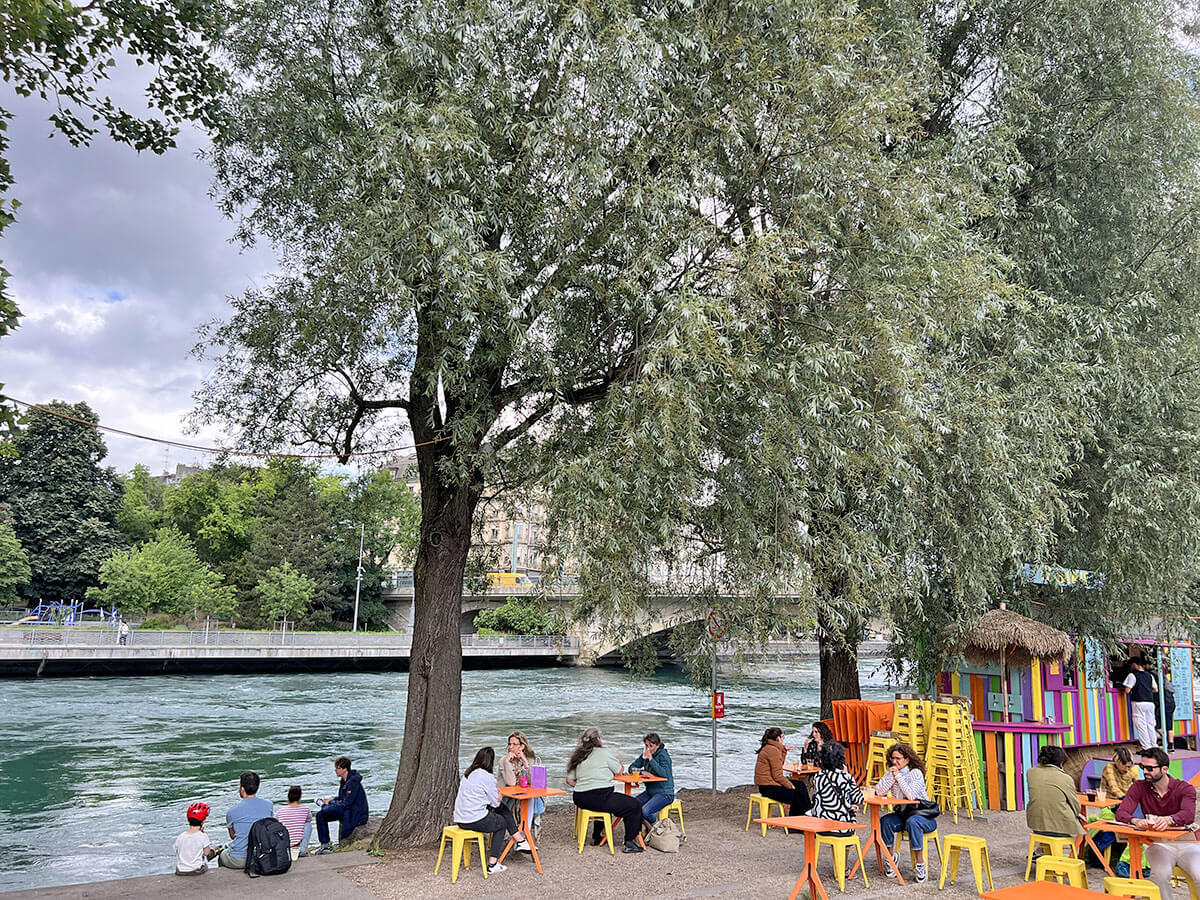
A place that I do recommend is La Barje des Lavandières, a terrace in the middle of the Rhône River, on Promenade des Lavandières, next to the Bâtiment des Forces Motrices theater, whose building by the way is beautiful. It is not a traditional restaurant, but rather a stall-style open-air bar with colorful tables and chairs to grab a bite in a delightful corner of Geneva. I only passed by at sunset and fell in love with the place. I don’t know how the food is, but according to the chalkboard there were, for example, pizzas for 10 francs or empanadas for 5 francs, ice creams, cakes, as well as all kinds of drinks. It’s only open in summer, from May to September, and at night there’s usually music and even some parties.
Things to do in Geneva with kids
I did this trip on my own, without my three little ones, but I kept taking note of everything they would have loved. And there’s quite a lot, because Geneva is a very easy city with kids: small, flat, with the lake everywhere and almost all the transport sorted.
The lake is the star attraction. Baby Plage has sand, swings hanging from the trees and toilets; the Bains des Pâquis lend board games at the ticket office and in summer they set up a zip line, a sandbox and children’s swimming lessons; and Les Bains du Jet d’Eau have a one-meter pool for those who can’t touch the bottom.
The little yellow boats, the mouettes, work like a ride for 2 francs (or free with the hotel’s transport card). Crossing the lake on one of them usually goes down better than any museum.
Museums that are free or almost free: the Red Cross Museum is free for under-12s and has interactive sections; the Ariana Museum and the Maison Tavel have a free permanent collection; and the CERN Science Gateway is free and designed for kids to touch things.
The Muséum d’Histoire Naturelle, the one with the dinosaurs, tends to appear on every list, but it has been closed for works since 2024 and doesn’t reopen until autumn 2026. Check before including it in your route.
There are playgrounds spread across half the city: at the Rampe de la Treille, in the Plainpalais square (with a skate park next to it) and near most of the accommodation on the outskirts.
And one practical thing that’s much appreciated: the water from the street fountains is drinkable, so with a refillable bottle you save yourself the constant drain of buying water, which you really notice in Switzerland.
How to get around Geneva

Public transport in Geneva works like a charm. What I used the most was the tram because it had a stop at my hotel door that took me straight to the center. There are several tram lines that connect the whole city and where it doesn’t reach, the bus network or the train with Cornavin station as the main hub does. To cross from one side of the lake to the other you can take the mouettes, the yellow boats.
In many hotels, they give you a transport card for free when you stay there to move around the city, allowing you to use everything I just told you. To leave the city you have to pay for a ticket or use the Swiss Travel Pass which I remind you also gives access to museums, many places of interest and gives you a 50% discount on cable cars and mountain trains.
The city center is quite manageable to do by walking on foot.
From the airport to the center you go by train in 6 minutes to Cornavin, with about five direct trains an hour. The ticket is 3 francs, but if you’re staying in Geneva you don’t need to buy it. I arrived by bus because my hotel was very close to the airport, although the train is what I recommend.
And let me clear up a myth that’s still doing the rounds: the free 80-minute ticket that a machine in the baggage hall used to give out was withdrawn in January 2022. If you read about it somewhere, it’s old information.
What is still going, and it’s much better, is the Geneva Transport Card: any hotel, hostel or campsite in Geneva gives it to you for free when you stay, these days it reaches you digitally by email up to three days before you arrive, and it covers trams, buses, zone 10 trains (airport included) and the mouettes for your whole stay.
If you’d rather pay per journey, the one-hour ticket costs 3 francs and the full-day one, 10. Even so, I mostly relied on the Swiss Travel Pass, because I was going on excursions outside the city almost every day.
And since it’s the question I get asked most: they don’t overlap as much as it seems. The hotel card covers the city and it’s free, so within Geneva you don’t need anything else. The Swiss Travel Pass pays off when you’re going to leave the city, because it covers trains and boats all over the country, gets you into museums and gives you 50% off most cable cars.
Frequently asked questions about what to see in Geneva
How many days do you need to see Geneva?
With one day you see the iconic sights of the center (Jet d’Eau, old town and lake) and with two you can enjoy it without rushing. But what I recommend is staying three days or more and using Geneva as a base: city, museums and at least one big excursion. That’s when the trip really starts to pay off.
Is Geneva expensive?
Yes, it’s one of the most expensive cities in the world, but you can see it on very little. The Jet d’Eau, the lakeside walks, the Botanical Garden, the Reformation Wall and the permanent collection of the Ariana Museum are free. The municipal museums are free on the first Sunday of the month, transport is free with your accommodation’s card and at the Pâquis buvette you can eat for about 15 francs.
How do you get from the airport to Geneva city center?
By train, and it’s ridiculously quick: 6 minutes to Cornavin station, with about five direct trains an hour. The ticket costs 3 francs (the one-hour Tout Genève), but if you’re staying in Geneva you don’t need it: your accommodation gives you the Geneva Transport Card for free and it covers that journey.
When does the Jet d'Eau run?
It’s free and runs every day. It’s usually switched on at around 10:00 (9:00 in summer) and switched off at nightfall. It’s stopped if there’s strong wind or frost, and it has a maintenance check in autumn, so don’t take it as a guarantee.
Where can I park in Geneva if I arrive by car?
The practical thing is to leave it at a P+R, the park-and-ride car parks on the outskirts, and go in by public transport. The day rate starts at 14 francs for one or two people and includes the all-day Tout Genève ticket. Parking in the center is expensive and restricted.
If you’re also going to drive on Swiss motorways, you need the vignette: it costs 40 francs, is valid from December 2025 to January 2027 and can be bought on paper or as an e-vignette on the official customs website. Without it, the fine is 200 francs.
What is there to do in Geneva with kids?
The best of it is on the lake: Baby Plage, the Bains des Pâquis and the little yellow boats. Add the Red Cross Museum (free for under-12s), the CERN Science Gateway and the Botanical Garden. I go into it in detail a little further up.
* This article includes affiliate links. If you book through them it costs you the same, you can even save money, and it generates a small commission for me that helps me continue creating interesting content.